VMware vs OpenStack
Table of contents
- Understanding VMware vSphere: The Established Leader
- Understanding OpenStack: The Open-Source Alternative
- VMware vs OpenStack: Critical Differences That Matter
- The Migration Question: Moving from VMware to OpenStack
- Use Cases: When VMware Makes Sense vs When OpenStack Wins
- The Data Protection Imperative: Why Both Platforms Need Backup
- VMware Backup: Requirements and Challenges
- OpenStack Backup: Unique Requirements and Approaches
- Ransomware Resilience: Protecting Infrastructure from Advanced Threats
- How Storware Protects VMware and OpenStack Environments
- Competitive Advantages: Why Organizations Choose Storware
- Making the VMware vs OpenStack Decision: What Matters Most
- Conclusion: Infrastructure Choices That Protect Your Future
The private cloud infrastructure market has been experiencing significant disruption recently. Broadcom’s acquisition of VMware and the resulting licensing changes have forced organizations worldwide to reassess their virtualization strategies. As IT leaders reassess their infrastructure investments, one question dominates planning sessions: should we continue with VMware, or is it time to migrate to OpenStack?
This decision has profound implications—not only for infrastructure costs and operational workflows, but also for long-term data protection strategies, disaster recovery capabilities, and ransomware resilience. Understanding the differences between VMware and OpenStack requires going beyond superficial comparisons and examining licensing models, total cost of ownership (TCO), vendor lock-in risks, and the often-overlooked issue of comprehensive backup and recovery.
Whether you’re evaluating alternatives to VMware’s new licensing structure or building cloud infrastructure from scratch, this guide explores what differentiates these platforms and what it takes to protect the mission-critical workloads running on them.
Understanding VMware vSphere: The Established Leader
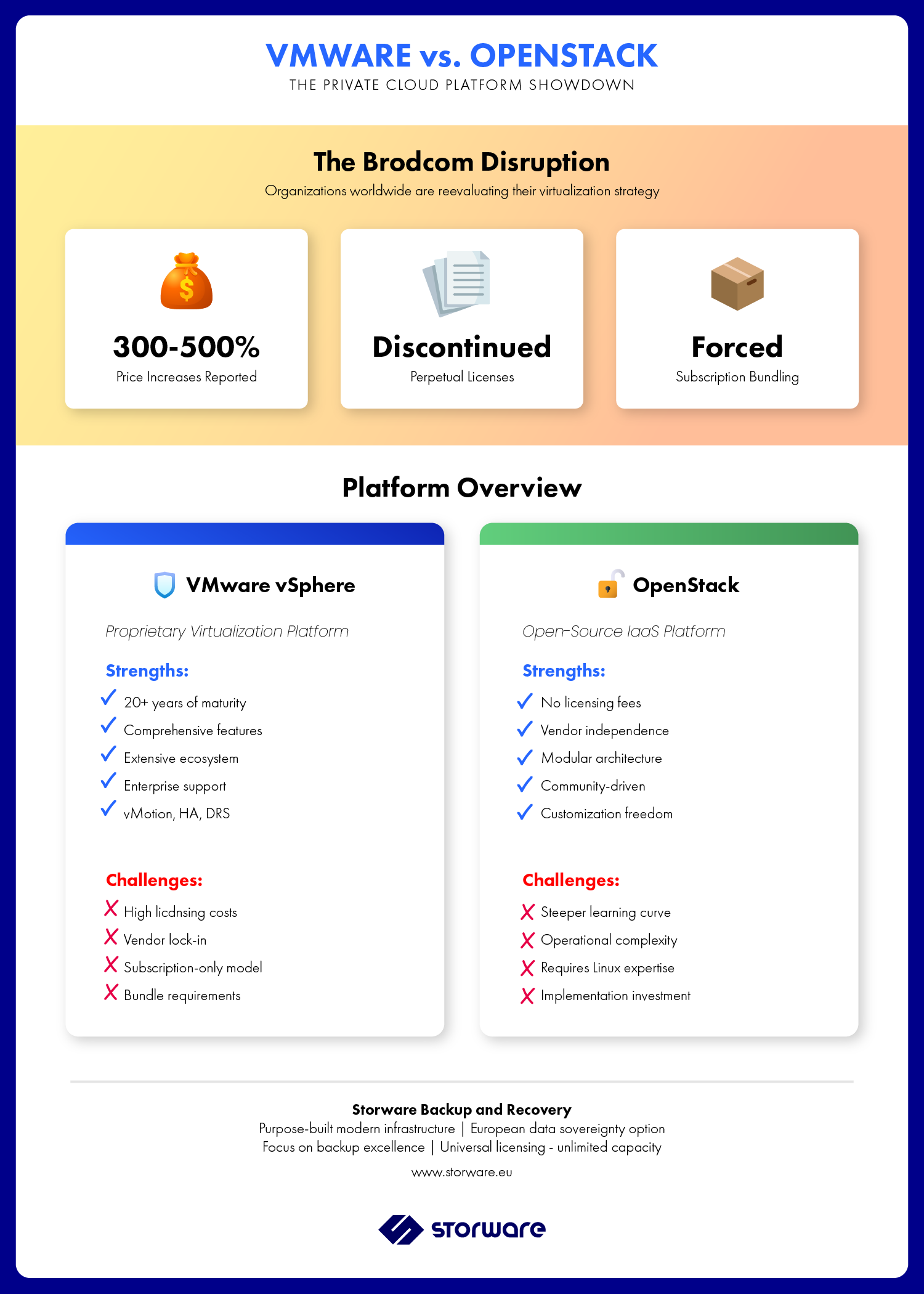
VMware vSphere has dominated enterprise virtualization for over two decades, becoming synonymous with private cloud infrastructure. The platform’s comprehensive feature set, mature ecosystem, and enterprise support have made it the default choice for organizations virtualizing their data centers.
vSphere offers server virtualization via the ESXi hypervisor, centralized management via vCenter Server, and enterprise features such as vMotion (live migration), high availability (HA), distributed resource scheduling (DRS), and storage vMotion. These capabilities enable organizations to maximize hardware utilization, reduce uptime, and simplify infrastructure management.
Key VMware vSphere characteristics:
- Industry-leading hypervisor with 20+ years of maturity
- Comprehensive management tools and automation capabilities
- Extensive hardware compatibility and vendor certification
- Rich ecosystem of third-party integrations and tools
- Enterprise-grade support with established SLAs
- Proven track record in mission-critical environments
VMware’s dominance extends beyond virtualization, encompassing networking (NSX), storage virtualization (vSAN), and cloud management (vRealize Suite). This comprehensive portfolio has created deep integration points but also significant vendor dependencies for many organizations. However, its acquisition by Broadcom in 2023 fundamentally changed VMware’s value proposition.
The new owner phased out perpetual licensing, introduced mandatory subscription models, bundled products into larger packages, and significantly increased pricing for many customers. These changes have transformed what was once a predictable infrastructure investment into a source of budget uncertainty and strategic concern.
Understanding OpenStack: The Open-Source Alternative
OpenStack represents a fundamentally different approach to cloud infrastructure—based on open source principles, community governance, and vendor independence. Introduced in 2010 by Rackspace and NASA, OpenStack has evolved into a production-grade IaaS platform, deployed by organizations ranging from CERN to Walmart, from telecommunications giants to financial institutions.
OpenStack provides the building blocks of a private cloud infrastructure through modular components: Nova (computing), Neutron (networking), Cinder (block storage), Swift (object storage), Glance (image storage service), and Keystone (identity). Organizations can select the components they need, integrate them with their existing infrastructure, and extensively customize them to their specific requirements.
Key OpenStack characteristics:
- Open-source architecture with no licensing costs
- Modular design allowing component selection
- Freedom from vendor lock-in and proprietary dependencies
- Support for multiple hypervisors (KVM, Xen, VMware ESXi, Hyper-V)
- Flexible storage backend integration (Ceph, traditional SAN, cloud storage)
- Active community with contributions from hundreds of companies
OpenStack doesn’t compete with VMware by replicating its exact features—instead, it offers a different philosophy. Where VMware provides an integrated, opinionated stack, OpenStack provides flexible building blocks. Where VMware offers commercial support from a single vendor, OpenStack offers choice among multiple support providers and integration partners.
The platform’s adoption has accelerated particularly among organizations seeking infrastructure independence, regulatory compliance flexibility, and protection against vendor pricing volatility. Telecommunications providers use OpenStack for network functions virtualization (NFV). Research institutions leverage it for large-scale scientific computing. Enterprises deploy it when data sovereignty or specialized infrastructure requirements preclude public cloud adoption.
VMware vs OpenStack: Critical Differences That Matter
Understanding the distinction between VMware and OpenStack requires examining multiple dimensions beyond basic feature comparisons:
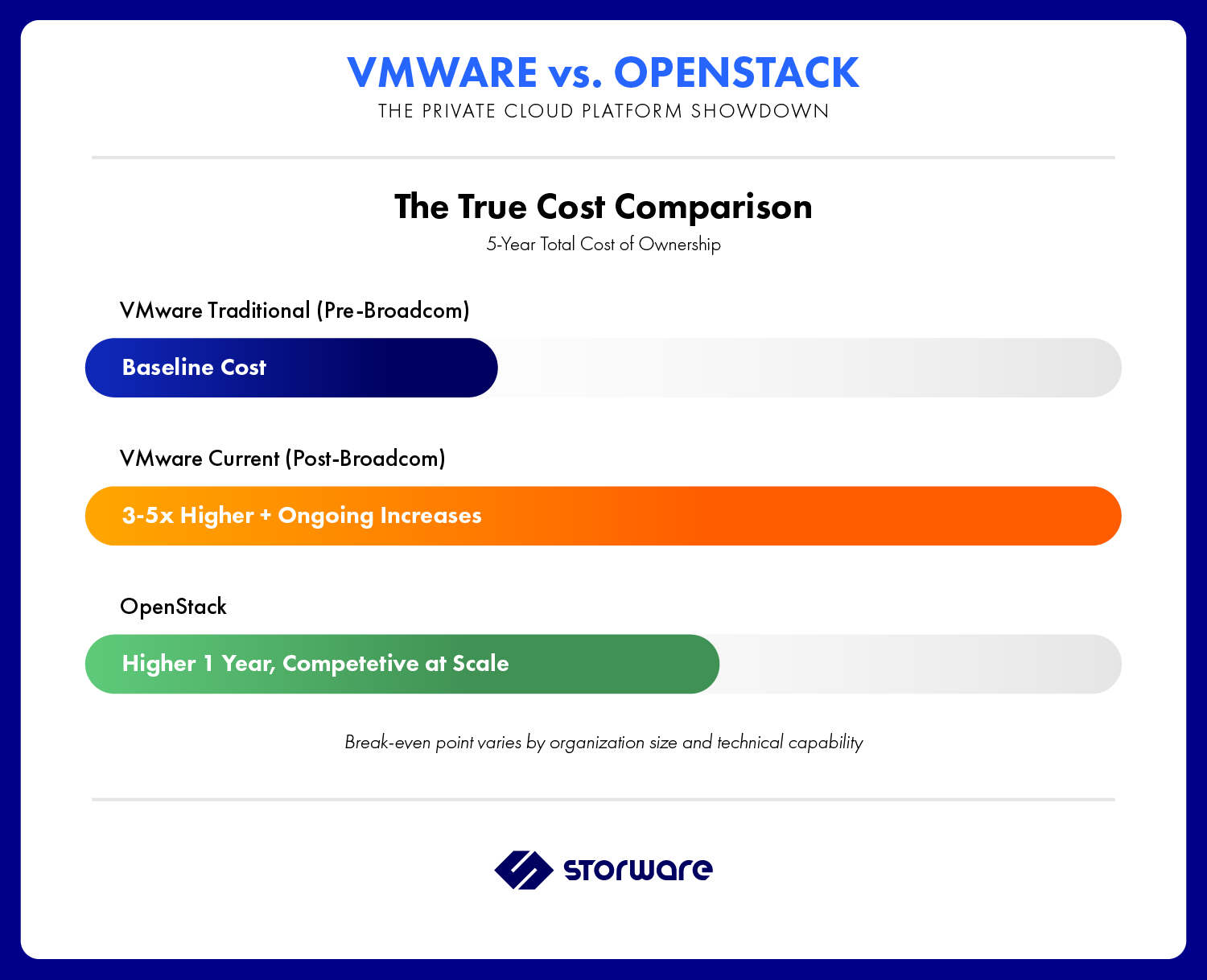
Licensing and Cost Structure: VMware operates on proprietary licensing with subscription fees based on CPU cores, feature bundles, and support tiers. Recent changes by Broadcom have dramatically increased costs for many organizations, with some reporting 300-500% price increases. OpenStack has no software licensing costs—expenses come from hardware, staffing, support contracts (optional), and operational overhead. Total cost comparisons depend heavily on scale, required features, and internal expertise.
Maturity and Stability: VMware vSphere benefits from 20+ years of continuous development, extensive testing, and proven stability in demanding enterprise environments. Updates follow predictable release cycles with thorough compatibility testing. OpenStack, while mature, has more variation in stability depending on distribution choices (Red Hat OpenStack Platform, Canonical OpenStack, SUSE OpenStack Cloud, or upstream deployments). Commercial distributions provide enterprise stability; community deployments require more expertise.
Feature Richness: VMware provides comprehensive features out-of-box including sophisticated DRS algorithms, predictive DRS, proactive HA, content libraries, vMotion encryption, and deep integration across the stack. OpenStack achieves similar capabilities through component combinations and configuration, but may require more architectural planning and integration work. Some VMware features (like certain vMotion capabilities) have no direct OpenStack equivalent, while OpenStack’s flexibility enables customizations impossible in VMware.
Management Complexity: VMware offers unified management through vCenter with consistent interfaces, extensive documentation, and familiar workflows for most IT professionals. OpenStack management varies by deployment—commercial distributions provide polished interfaces (Horizon dashboard, command-line tools), but require understanding of underlying components and architecture. The learning curve for OpenStack is steeper, particularly for teams without Linux and open-source experience.
Ecosystem and Integration: VMware benefits from decades of third-party integrations, hardware certification programs, and vendor partnerships. Nearly every enterprise software vendor ensures VMware compatibility. OpenStack’s ecosystem has grown substantially, with major hardware vendors supporting deployments and numerous software integrations available, but the integration landscape remains more fragmented.
Vendor Lock-in vs Freedom: VMware creates significant lock-in through proprietary formats, licensing dependencies, and feature integration across products. Migration away from VMware requires substantial effort. OpenStack, by design, avoids vendor lock-in—you can change distributions, support providers, or underlying components without starting over. This freedom carries the responsibility of maintaining portability.
Support and Accountability: VMware provides centralized enterprise support with clear escalation paths, TAM (Technical Account Manager) programs, and single-vendor accountability. OpenStack support comes from distribution vendors (Red Hat, Canonical, SUSE), independent support providers, or community resources. Organizations must decide whether centralized support or vendor choice better serves their needs.
The Migration Question: Moving from VMware to OpenStack
Broadcom’s VMware licensing changes have accelerated migration discussions at organizations worldwide. However, moving from VMware to OpenStack isn’t a simple lift-and-shift operation—it requires careful planning, phased execution, and realistic expectations.
Migration drivers currently motivating organizations:
- Cost reduction in response to VMware price increases (primary driver for most)
- Vendor independence to avoid future pricing volatility
- Regulatory compliance requiring open-source infrastructure
- Cloud-native transformation initiatives
- Desire for infrastructure customization beyond VMware capabilities
- Strategic alignment with open-source philosophy
Migration challenges organizations must address:
- Application compatibility and testing requirements
- Operational workflow changes and team retraining
- Integration with existing tools and management platforms
- Network architecture differences (VMware NSX vs Neutron)
- Storage migration and performance validation
- Backup and disaster recovery strategy adaptation
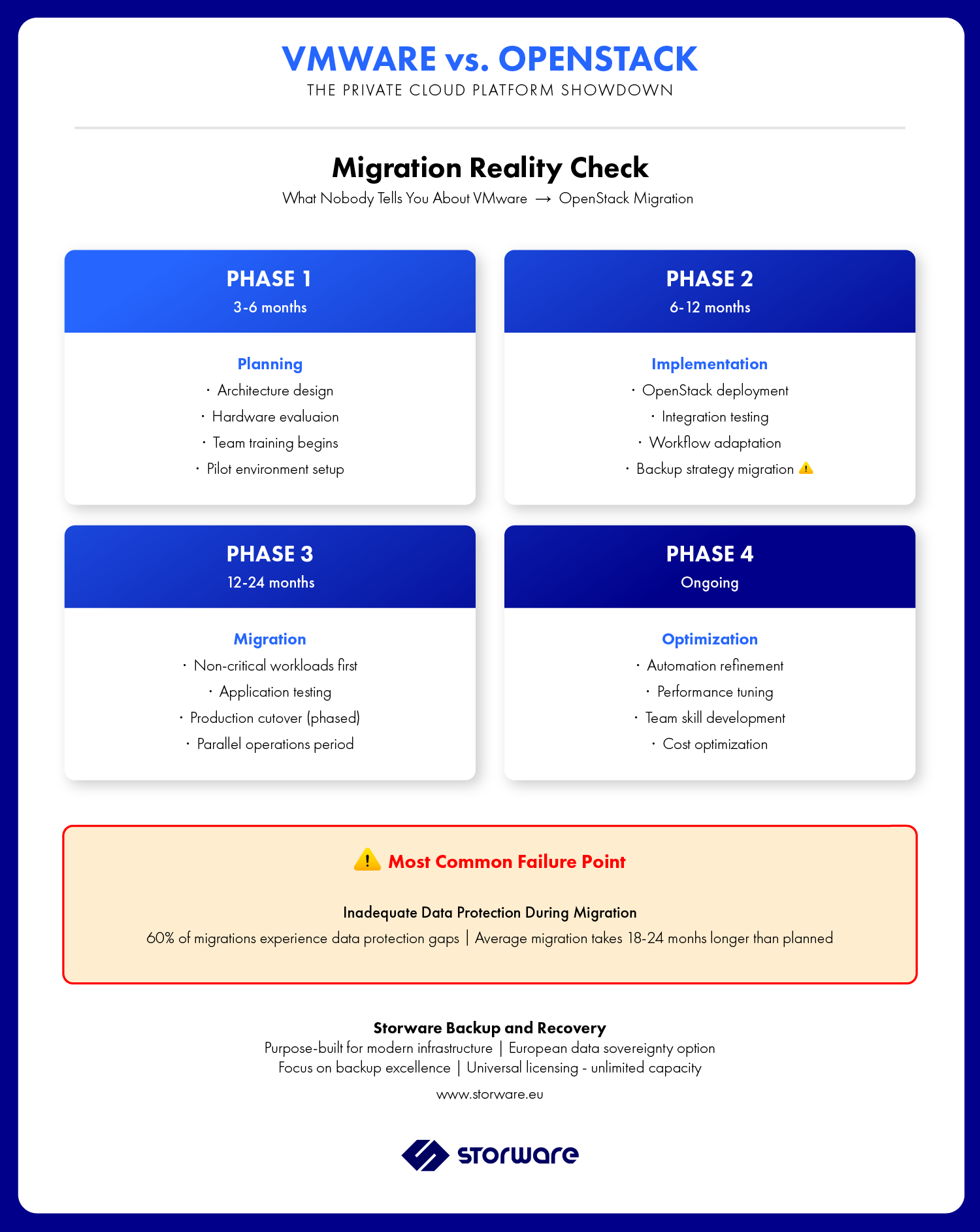
Successful migrations typically follow phased approaches: starting with non-critical workloads, establishing operational competency, then progressively migrating production systems. Organizations rarely migrate everything—hybrid deployments running both platforms during transition periods are common.
The migration decision shouldn’t focus solely on avoiding VMware costs. Organizations must factor in OpenStack implementation expenses, staffing requirements, potential productivity impacts during transition, and ongoing operational costs. For some organizations, OpenStack provides compelling economics and strategic benefits. For others, VMware remains the better choice despite pricing increases. The decision depends on specific circumstances, internal capabilities, and long-term strategic direction.
Use Cases: When VMware Makes Sense vs When OpenStack Wins
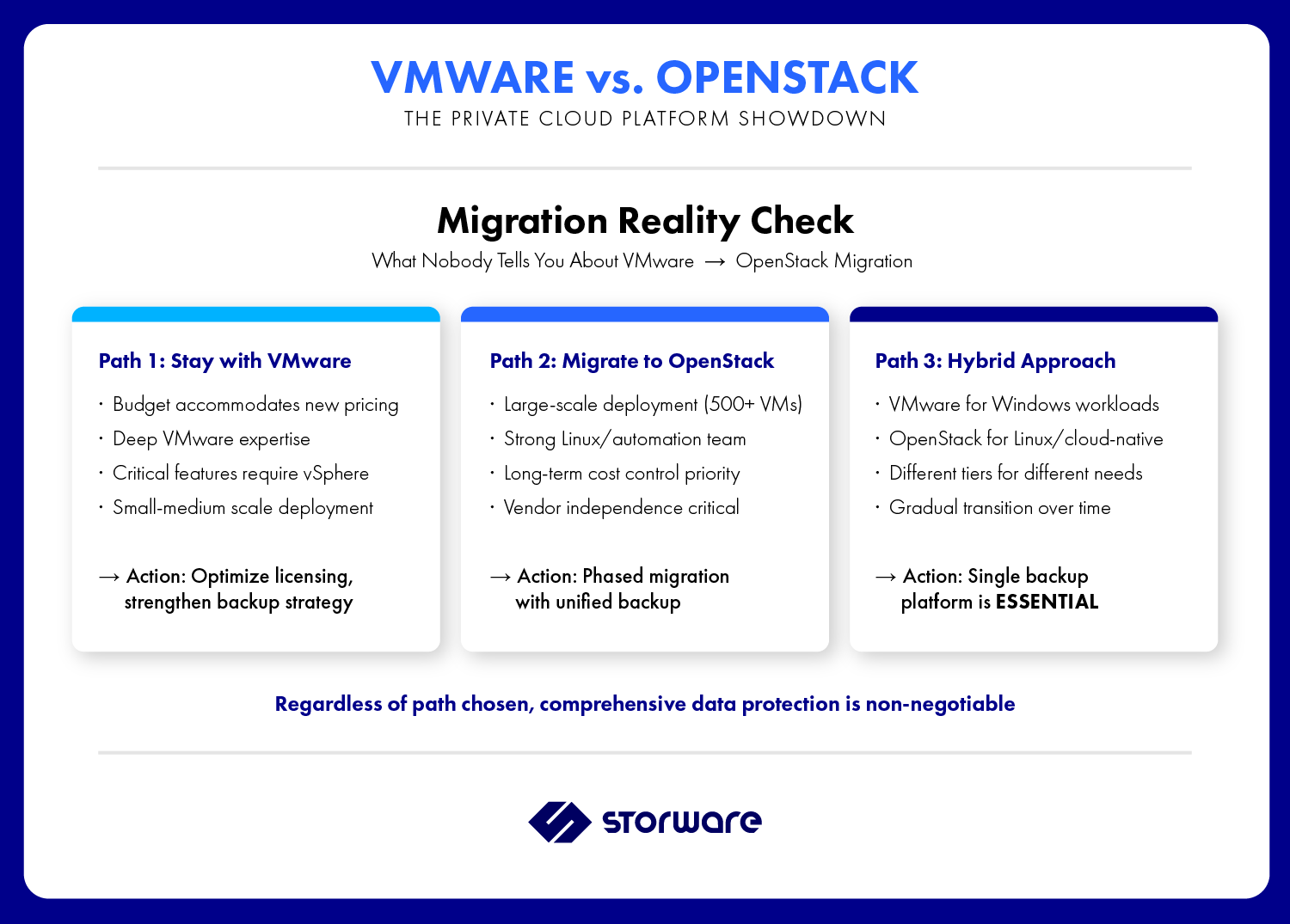
Choose VMware vSphere when:
- Running Windows-heavy environments with deep Microsoft integration
- Requiring mature features like DRS, vMotion encryption, and content libraries without custom development
- Staffing constraints limit ability to build OpenStack expertise
- Time-to-deployment is critical and learning curves must be minimized
- Specific applications require VMware certification or depend on VMware features
- Small to medium scale deployments where licensing costs remain manageable
- Risk tolerance for vendor dependency is higher than tolerance for operational complexity
Organizations with small IT teams, limited Linux expertise, or demanding uptime requirements often continue finding value in VMware’s integrated approach despite pricing concerns.
Choose OpenStack when:
- Building large-scale private clouds where licensing costs become prohibitive
- Infrastructure independence and vendor neutrality are strategic priorities
- Regulatory requirements favor open-source solutions or specific data sovereignty needs
- Requiring infrastructure customization beyond what VMware enables
- Technical teams have Linux, automation, and infrastructure-as-code expertise
- Long-term cost predictability outweighs short-term implementation complexity
- Running workloads that benefit from OpenStack’s flexible architecture (NFV, HPC, research computing)
Telecommunications providers, research institutions, government agencies, and large enterprises with strong technical teams frequently find OpenStack better aligns with their needs, especially at scale.

The Data Protection Imperative: Why Both Platforms Need Backup
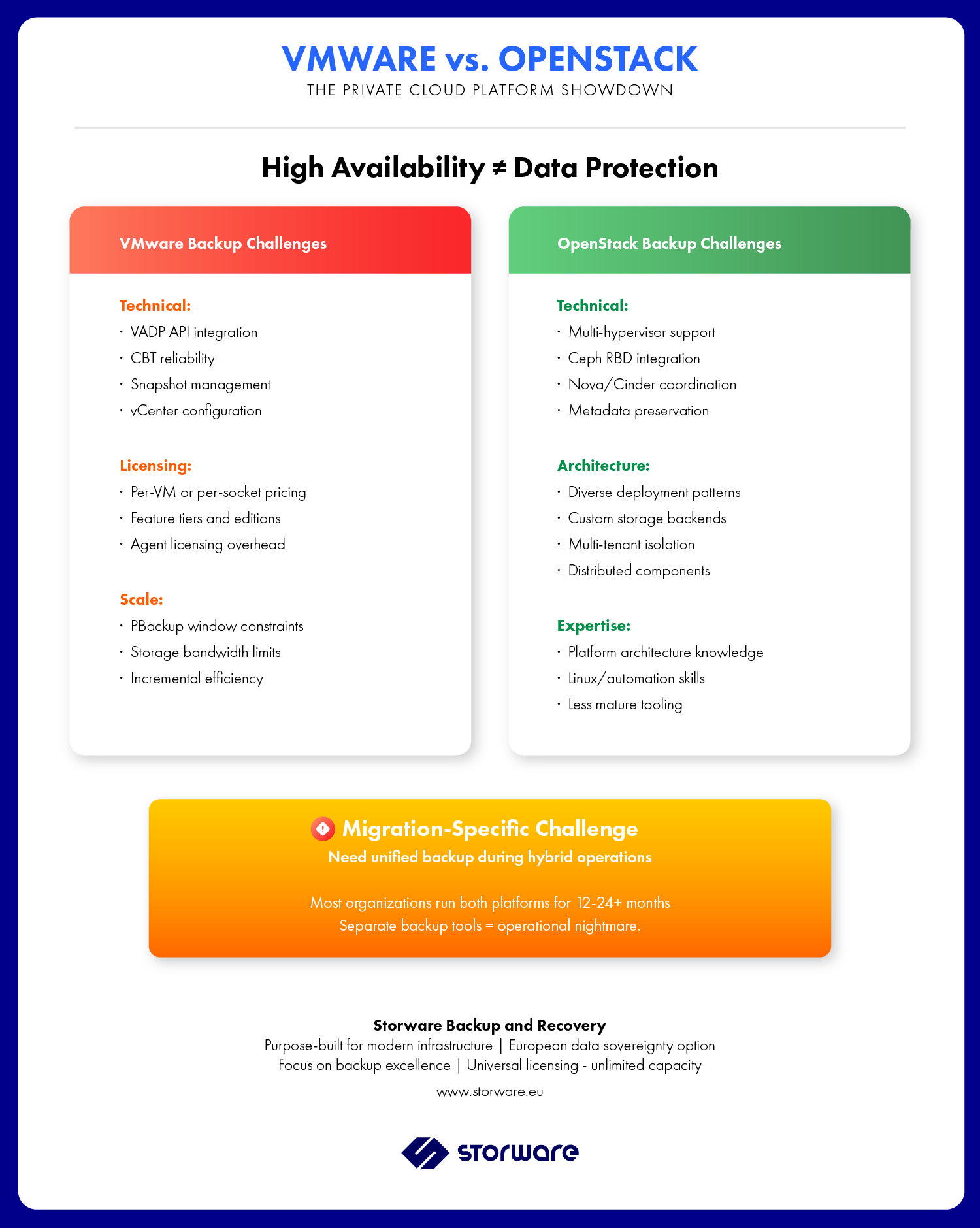
Regardless of whether you choose VMware or OpenStack, comprehensive data protection is non-negotiable. Both platforms include high availability features that protect against hardware failures and provide uptime resilience—but high availability does not equal data protection.
What high availability protects against:
- Hardware failures (server, storage, network)
- Planned maintenance and upgrades
- Resource contention and performance issues
What high availability does NOT protect against:
- Ransomware attacks encrypting production data
- Accidental deletion by administrators or users
- Data corruption from application bugs or storage failures
- Compliance requirements for long-term data retention
- Insider threats or malicious activity
- Disaster scenarios affecting entire data centers
Recent statistics paint a sobering picture: ransomware attacks increased 150% year-over-year, with 75% specifically targeting virtualization infrastructure and backup systems. The average cost of data loss exceeds $4.35 million per incident. Most critically, 93% of companies unable to recover data within 10 days file for bankruptcy within a year.
Organizations migrating from VMware to OpenStack often focus intensely on infrastructure compatibility and performance while underestimating backup strategy complexity. This oversight creates dangerous vulnerability windows where production systems run without adequate protection. Whether keeping VMware, adopting OpenStack, or running both during transition, data protection must be part of the conversation from day one.
VMware Backup: Requirements and Challenges
VMware environments have mature backup ecosystems with numerous solutions available. However, effective VMware backup requires more than selecting a tool—it demands understanding of VMware’s architecture, storage APIs, and operational implications.
VMware backup must address:
- Virtual machine image-level backup using VMware VADP (vStorage APIs for Data Protection)
- Application-consistent backups for databases (SQL Server, Oracle, Exchange) and other stateful applications
- Changed Block Tracking (CBT) for incremental backup efficiency
- vCenter configuration and metadata protection
- vSAN datastore backup and disaster recovery
- VM encryption and security policy preservation
- Multi-tenancy and resource pool isolation
Most VMware backup solutions rely on VADP APIs that VMware provides specifically for backup integration. These APIs enable hot backups without impacting running VMs, support incremental backups through CBT, and provide application-aware snapshots. However, backup strategies must account for VADP limitations, snapshot storage overhead, and coordination with storage systems.
Organizations often discover backup complexity scales non-linearly with environment size. Protecting 50 VMs differs substantially from protecting 5,000 VMs—bandwidth, storage, backup windows, and management overhead all become critical constraints requiring sophisticated solutions.
OpenStack Backup: Unique Requirements and Approaches
OpenStack backup presents different challenges compared to VMware environments. The platform’s flexibility and architectural choices create scenarios where one-size-fits-all backup approaches fail.
OpenStack backup must address:
- Virtual machine protection across different hypervisors (primarily KVM, but potentially others)
- Ceph storage backup including RBD (RADOS Block Device) volumes
- Cinder volume protection independent of VM backups
- Swift object storage backup for unstructured data
- Instance metadata, flavor definitions, and networking configurations
- Multi-tenant isolation ensuring backup data separation
- Integration with OpenStack APIs for backup orchestration
OpenStack’s modular architecture means backup solutions must understand multiple storage backends, diverse deployment patterns, and varied configurations. Unlike VMware’s standardized APIs, OpenStack backup requires deeper integration with platform components and flexible adaptation to different architectural choices.
Organizations deploying OpenStack frequently use Ceph for block and object storage. Backing up Ceph effectively requires understanding its distributed architecture, leveraging RBD snapshots efficiently, and coordinating backup across cluster nodes. Traditional backup approaches designed for centralized storage systems often perform poorly in Ceph environments.
The migration scenario introduces additional backup complexity: organizations running both VMware and OpenStack during transition need solutions that protect both platforms simultaneously. Managing separate backup tools for each platform increases operational overhead, training requirements, and licensing costs while creating potential gaps in protection coverage.
Ransomware Resilience: Protecting Infrastructure from Advanced Threats
Ransomware has evolved from opportunistic attacks on individual systems to sophisticated operations targeting entire infrastructure platforms. Modern ransomware specifically seeks virtualization infrastructure, storage systems, and backup repositories—the exact components that enterprises depend on for recovery.
Both VMware and OpenStack environments require multi-layered ransomware resilience:
Immutable Backup Storage: Creating backups only protects data if ransomware cannot encrypt or delete those backups. Immutable storage prevents any modification of backup data, even by privileged administrators whose credentials may be compromised. This capability transforms backups from potential ransomware targets into guaranteed recovery points.
Air-Gapped Backup Copies: Physical or logical isolation of backup copies provides additional protection layers. Air-gapped backups remain unreachable from production networks, ensuring ransomware cannot propagate to backup infrastructure regardless of how deeply attackers penetrate production environments.
Rapid Recovery at Scale: When ransomware encrypts infrastructure, recovery speed determines business survival. Organizations need backup solutions that can rapidly restore dozens, hundreds, or thousands of virtual machines simultaneously—not recover them one at a time over days or weeks.
Verified Recoverability: Backups provide no value if they cannot be restored. Regular recovery testing, automated backup validation, and proven restore procedures ensure that backup systems work when disasters strike. Many organizations discover backup failures only when attempting recovery during actual incidents.

How Storware Protects VMware and OpenStack Environments
Storware provides comprehensive, agentless backup and recovery specifically designed for virtualized and cloud infrastructure. Unlike backup vendors that built solutions for physical servers and later retrofitted virtualization support, Storware Backup and Recovery was architected from the beginning for modern infrastructure platforms.
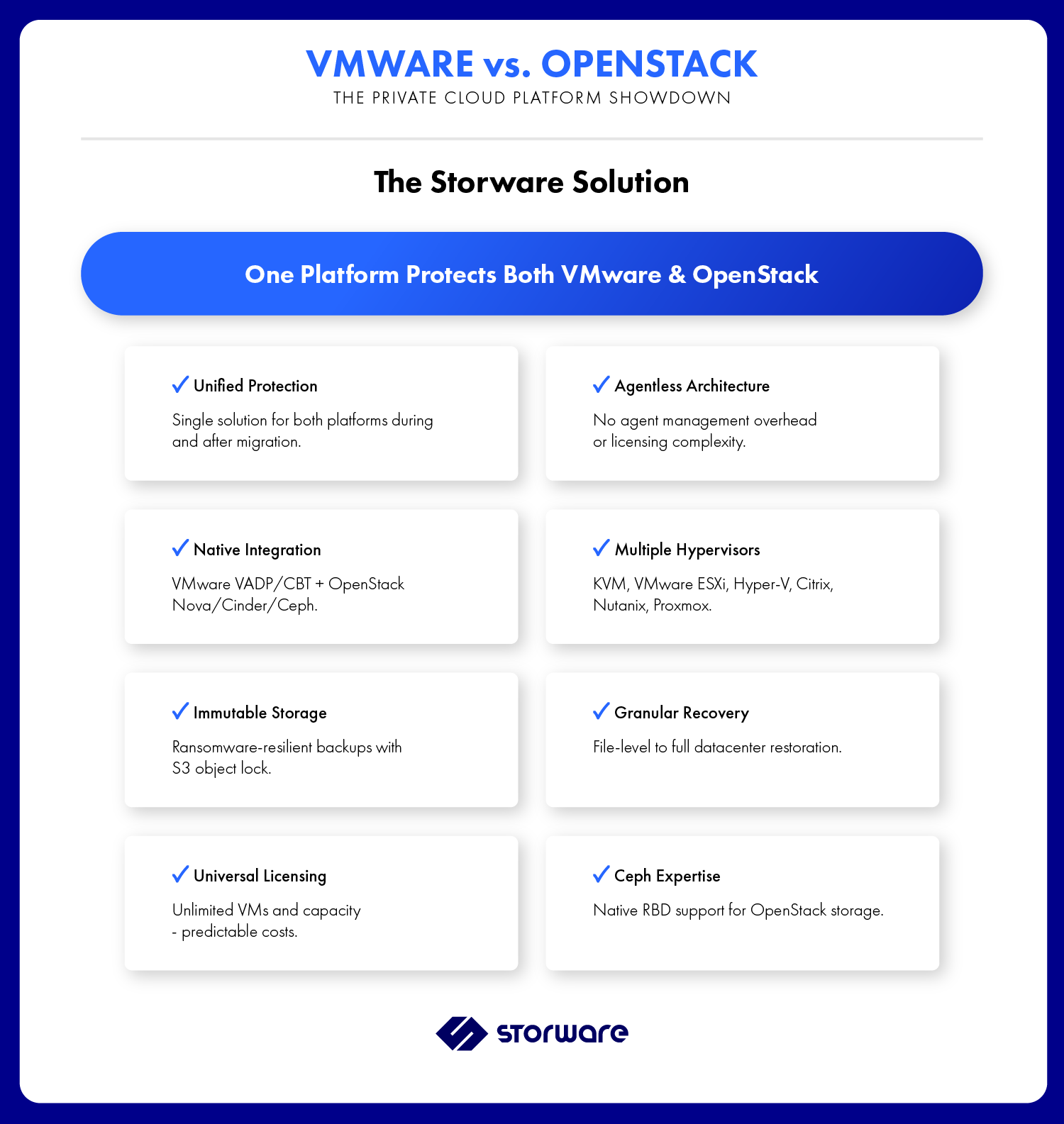
Unified Protection for VMware and OpenStack: Organizations don’t need separate backup tools for VMware and OpenStack environments. Storware provides a single platform protecting both, which proves invaluable during VMware-to-OpenStack migrations. You maintain consistent data protection policies, unified management, and centralized recovery capabilities regardless of underlying infrastructure—eliminating dangerous protection gaps during transition periods.
Native Integration with Both Platforms: For VMware environments, Storware leverages vStorage APIs for Data Protection (VADP) with full Changed Block Tracking (CBT) support, enabling efficient incremental backups without agent deployment. For OpenStack, Storware integrates directly with Cinder, and Ceph, supporting RBD snapshots and volume-level backups optimized for distributed storage architectures.
Agentless Architecture: Storware eliminates the operational burden of managing backup agents across thousands of VMs. Agent-based solutions require installation, updates, troubleshooting, and license management for every protected VM. As environments scale, agent management becomes overwhelming. Storware’s agentless approach integrates at the platform level, automatically protecting VMs regardless of operating system or application stack.
Support for Multiple Hypervisors: Organizations running mixed environments benefit from Storware’s support for KVM, VMware ESXi, Hyper-V, Citrix XenServer, Nutanix AHV, Proxmox, and OLVM. This flexibility proves essential during infrastructure transitions or in heterogeneous environments where different hypervisors serve different purposes.
Ceph Storage Expertise: Many OpenStack deployments use Ceph for block and object storage. Storware provides deep Ceph integration, understanding RBD architecture and leveraging Ceph-native capabilities for efficient backup. This expertise distinguishes Storware from backup vendors treating Ceph as generic storage.
Immutable Backup Storage: Storware enables integration with immutable storage targets including S3-compatible object storage with object lock, tape libraries, and purpose-built backup appliances. These integrations ensure ransomware cannot compromise backup data, providing guaranteed recovery points even after catastrophic attacks.
Flexible Backup Destinations: Storware supports diverse backup targets including NFS shares, S3-compatible object storage, cloud storage, and tape libraries. Organizations can implement multi-tier storage strategies with frequent backups to fast storage and long-term retention to cost-effective cloud or tape.
Granular Recovery Options: Whether recovering individual files from VM disks, restoring entire VMs, or performing mass recovery of entire data centers, Storware provides flexibility. File-level recovery eliminates the need to restore complete VMs just to retrieve specific files. VM-level recovery supports both in-place restoration and alternate-location recovery for testing or migration scenarios.
Licensing Model: Storware’s licensing approach eliminates the complexity and cost uncertainty. It is tailored to the needs and requirements of the client and its infrastructure.
Competitive Advantages: Why Organizations Choose Storware
The backup and recovery market includes established vendors like Veeam (the VMware backup leader), Commvault, and Rubrik. However, these solutions were optimized primarily for VMware environments and often struggle with OpenStack and diverse infrastructure scenarios.
Purpose-Built for Modern Infrastructure: While legacy vendors started with physical server backup and added virtualization support later, Storware built its platform specifically for virtualized and cloud infrastructure. This focus results in better performance, more reliable backups, and simpler operations in environments Storware was designed to protect.
True Multi-Platform Support: Veeam dominates VMware backup but provides limited OpenStack support. Storware treats both VMware and OpenStack as first-class platforms with equal feature richness, making it ideal for organizations running both or contemplating migration. Organizations don’t need to choose between best-in-class VMware backup or adequate OpenStack protection—Storware delivers both.
No Agent Management Overhead: Competitors requiring agents on every VM introduce operational complexity that scales linearly with environment size. Protecting 1,000 VMs means managing 1,000 agents—installations, updates, troubleshooting, and license tracking. Storware’s agentless architecture eliminates this overhead entirely, dramatically reducing operational burden.
Cost Predictability: Many backup vendors use complex licensing models charging per VM, per terabyte, per socket, or combining multiple factors. With Storware you can choose what best fits your needs, enabling accurate long-term budget planning without surprise expenses.
Focus on Core Excellence: Some vendors have expanded into adjacent markets including security, monitoring, and cloud management. Storware maintains singular focus on backup and recovery excellence. This specialization results in more robust data protection capabilities, deeper platform integrations, and faster innovation in core backup functionality.
European Data Sovereignty: For organizations with European operations, GDPR compliance requirements, or data sovereignty concerns, Storware’s Polish headquarters and European focus provide an alternative to US-based vendors. This consideration has grown increasingly important as data protection regulations tighten globally.
Making the VMware vs OpenStack Decision: What Matters Most
Choosing between VMware and OpenStack—or deciding whether to migrate from one to the other—ranks among the most consequential infrastructure decisions organizations make. The wrong choice creates years of technical debt, operational inefficiency, or financial burden. The right choice enables digital transformation, cost optimization, and strategic flexibility.
Evaluate based on these factors:
- Total cost of ownership including licensing, staffing, training, and operational expenses over 3-5 years
- Internal technical capabilities and willingness to develop OpenStack expertise
- Scale and growth projections—at what point does OpenStack economics become advantageous?
- Regulatory and compliance requirements favoring open-source or proprietary solutions
- Application dependencies and certification requirements
- Risk tolerance for vendor lock-in versus operational complexity
- Migration complexity and business disruption potential
- Strategic alignment with broader technology direction
For many organizations, the decision isn’t binary. Hybrid approaches keeping VMware for certain workloads while deploying OpenStack for others often prove optimal. Some keep VMware for Windows-heavy environments while moving Linux workloads to OpenStack. Others keep VMware for tier-1 applications while using OpenStack for development, testing, and less-critical production.
Regardless of platform choice, comprehensive backup and recovery must be part of initial planning—not an afterthought implemented months after production deployment. The cost of data loss far exceeds any backup solution investment. Recovery capabilities determine whether infrastructure failures become minor incidents or business-ending disasters.
Conclusion: Infrastructure Choices That Protect Your Future
The market is clearly moving toward OpenStack as organizations seek greater independence, cost predictability, and long-term control over their infrastructure. Driven by licensing changes and vendor lock-in concerns, many enterprises are actively re-evaluating VMware and planning migration paths toward open, vendor-neutral platforms.
OpenStack offers key advantages over VMware, including freedom from proprietary licensing, architectural flexibility, stronger data sovereignty, and the ability to tailor infrastructure precisely to business needs. At the same time, OpenStack is not without challenges — from higher architectural complexity to the need for deep operational expertise, especially around storage, recovery, and day-2 operations. This is exactly where experience matters.
At Storware, we have been working with OpenStack environments for years, long before today’s migration wave began, and we deeply understand both their strengths and their real-world operational risks. We specialize in backup and recovery for OpenStack at scale, helping organizations protect Ceph, Cinder, KVM, and complex multi-tenant architectures without compromising performance or control.
As enterprises migrate now, we are already here — ready with proven solutions, battle-tested integrations, and expertise built through years of real deployments.
And for organizations that choose to remain on VMware, Storware continues to deliver enterprise-grade, agentless backup with the same focus on resilience, simplicity, and ransomware protection. No matter where you are on your infrastructure journey, Storware ensures your data stays protected, recoverable, and under your control.
