
Table of Contents
Why 7.5 Matters: The Infrastructure Landscape Has Shifted
Over the past two years, enterprise infrastructure teams have been making moves that would have seemed unlikely before Broadcom’s VMware acquisition: serious, production-scale migrations to OpenStack, XCP-ng, Proxmox, and Nutanix. What started as a cost-driven reaction is now a deliberate architectural choice. The question is no longer whether to run heterogeneous environments — it’s how to protect them reliably.
Storware Backup and Recovery 7.5 is built around that reality. As Paweł Mączka, CEO of Storware, put it ahead of this release:
“OpenStack is no longer a niche choice — it’s where serious infrastructure decisions are being made. This release reflects that. We’ve deepened our backup capabilities for OpenStack workloads and strengthened the integrations our partners actually rely on. Heterogeneous environments are the norm now, not the exception, and we intend to stay ahead of that curve.”
Below is a technical walkthrough of every significant change in 7.5 — what it does, why it was built, and what it means for your environment.
What’s New in Storware Backup and Recovery 7.5
Throughout the entire process, we experienced benefits such as reduced transportation and storage needs for extinguishers, both before customer visits and during site delivery. The smaller footprint on-site simplified servicing and upkeep. Installation time was cut in half. Additionally, we minimized waste due to less packaging material.
Strategic Integration with Platform9
Platform9 is an enterprise private cloud provider whose flagship product, Private Cloud Director, delivers SaaS-managed OpenStack and Kubernetes infrastructure. Organizations running Platform9 get the operational simplicity of a managed control plane without sacrificing the architecture of a fully open platform.
Version 7.5 introduces native integration with Platform9, meaning workloads running on Platform9-managed OpenStack clusters can now be protected directly through Storware Backup and Recovery — with the same policy-driven backup scheduling, granular restore, and multi-destination support available for every other supported hypervisor.
This is a significant step for organizations that chose Platform9 precisely because it removes operational friction. Backup should work the same way.
V2V Migration: Citrix Hypervisor and XCP-ng to OpenStack
Storware has supported VM-to-VM (V2V) migration from VMware to OpenStack for some time. Version 7.5 extends that capability to two additional source platforms: Citrix Hypervisor and XCP-ng.
For organizations currently running Citrix or XCP-ng environments that are planning — or mid-execution on — an OpenStack migration, this closes an important gap. The migration path is handled within the same backup workflow: VMs are backed up from the source hypervisor and can be cross-restored directly into an OpenStack environment, with no additional migration tooling required.
Operationally, this means:
- No vendor lock-in constraint when moving from Citrix or XCP-ng
- Migration progress can be staged — workloads move on your schedule, not the hypervisor vendor’s
- The same backup infrastructure that protects production workloads also drives the migration
VMware-to-OpenStack migration support remains available and continues to be the most-requested migration path in the platform.
Nutanix: v4 API Support and a Redesigned VM Backup Workflow
Nutanix has been steadily moving its platform APIs from v3 to v4, and v4 brings a materially different approach to how VMs and storage are represented. The headline change relevant to backup: the shift to volume groups as the backing construct for VM disks in v4.
Storware 7.5 introduces full Nutanix v4 API support, including a redesigned VM backup workflow that leverages volume groups correctly. The practical benefits are improved performance at scale, better alignment with how Nutanix AHV actually manages storage under v4, and forward compatibility as Nutanix continues evolving the platform. Organizations running Nutanix at scale will find this particularly relevant — v4 support is the foundation for performance and reliability improvements that aren’t possible on the older API.
Proxmox: Ceph v19 Support and Synthetic Backup via SSH
Two independent improvements for Proxmox environments landed in 7.5:
Ceph v19 compatibility. Proxmox deployments using Ceph as a storage backend can now upgrade to Ceph v19 without breaking backup support. This was a dependency constraint for a meaningful portion of Proxmox + Ceph users who were holding back on the Ceph upgrade to avoid disrupting their backup pipeline. That blocker is now removed.
Synthetic backup via SSH transfer strategy. Storware 7.5 adds support for using a synthetic backup destination with Proxmox environments using the SSH transfer strategy. Synthetic backups — sometimes called forever-incremental — maintain a virtual full backup by merging incrementals, which reduces backup windows, lowers storage load, and cuts network consumption significantly in environments with large or frequently-changing VMs. This is particularly effective for Proxmox deployments where backup windows were being stretched by full backup frequency.
OpenStack: Inventory Sync, Partial Project Updates, Metadata Protection, and Multithreaded Reads
Several targeted improvements were made to the OpenStack integration in 7.5, each addressing specific pain points observed in production deployments:
- Faster and more granular inventory synchronization. Inventory sync now runs faster with optional domain scanning, so large multi-tenant OpenStack environments don’t pay a full-inventory cost when only a subset of projects needs to be refreshed.
- API-driven partial project inventory synchronization. Projects can now be updated independently via API, which is important for dynamic environments where new projects are provisioned frequently. Previously, a full sync was required to pick up new projects — now it’s targeted and on-demand.
- Enhanced backup metadata protection. Recovery consistency has been improved through better protection of backup metadata. In practice, this reduces the risk of partial or inconsistent restores in edge-case failure scenarios.
- Multithreaded reads for OpenStack and OpenShift Virtualization. Backup throughput for both OpenStack and OpenShift Virtualization workloads gets a significant boost from new multithreaded read support. For environments with large VMs or high-IOPS workloads, this is the most immediately impactful performance change in the release.
OS Agent: Metadata Database Reliability and Purge Optimization
Two improvements to the OS Agent address operational correctness in large and multi-tenant environments:
Metadata database reliability. The OS Agent’s internal metadata database handling has been made more robust, reducing the risk of corruption or inconsistency under heavy load or unexpected process termination.
Optimized object comparison in the purge process. Purge operations — which clean up expired backup data — now perform object comparison faster. In large environments with many retained restore points, this was a source of operational delay. The optimization makes purge significantly more efficient, which matters in multi-tenant environments where purge operations compete with ongoing backup schedules.
7.5 at a Glance: Key Changes by Platform
| Platform / Component | Change | Impact |
|---|---|---|
| Platform9 | New native integration | Full backup/restore support for Platform9-managed OpenStack and Kubernetes workloads |
| V2V Migration | Citrix Hypervisor and XCP-ng → OpenStack | Vendor-neutral migration path; no additional tooling required |
| Nutanix | v4 API support; redesigned backup workflow using volume groups | Improved performance and forward compatibility with current Nutanix AHV architecture |
| Proxmox | Ceph v19 compatibility | Unblocks Ceph upgrades without disrupting backup pipelines |
| Proxmox | Synthetic backup via SSH transfer strategy | Reduced backup windows, storage load, and network consumption |
| OpenStack | Faster inventory sync with optional domain scanning | Lower overhead in large multi-tenant environments |
| OpenStack | Partial project inventory sync via API | On-demand, targeted project refresh without full-inventory cost |
| OpenStack / OpenShift Virtualization | Multithreaded reads | Major backup throughput improvement for large workloads |
| OpenStack | Enhanced backup metadata protection | Improved recovery consistency in edge-case failure scenarios |
| OS Agent | Metadata database reliability improvements | Reduced risk of corruption under load or unexpected shutdown |
| OS Agent | Optimized object comparison in purge | Faster purge operations in large and multi-tenant environments |
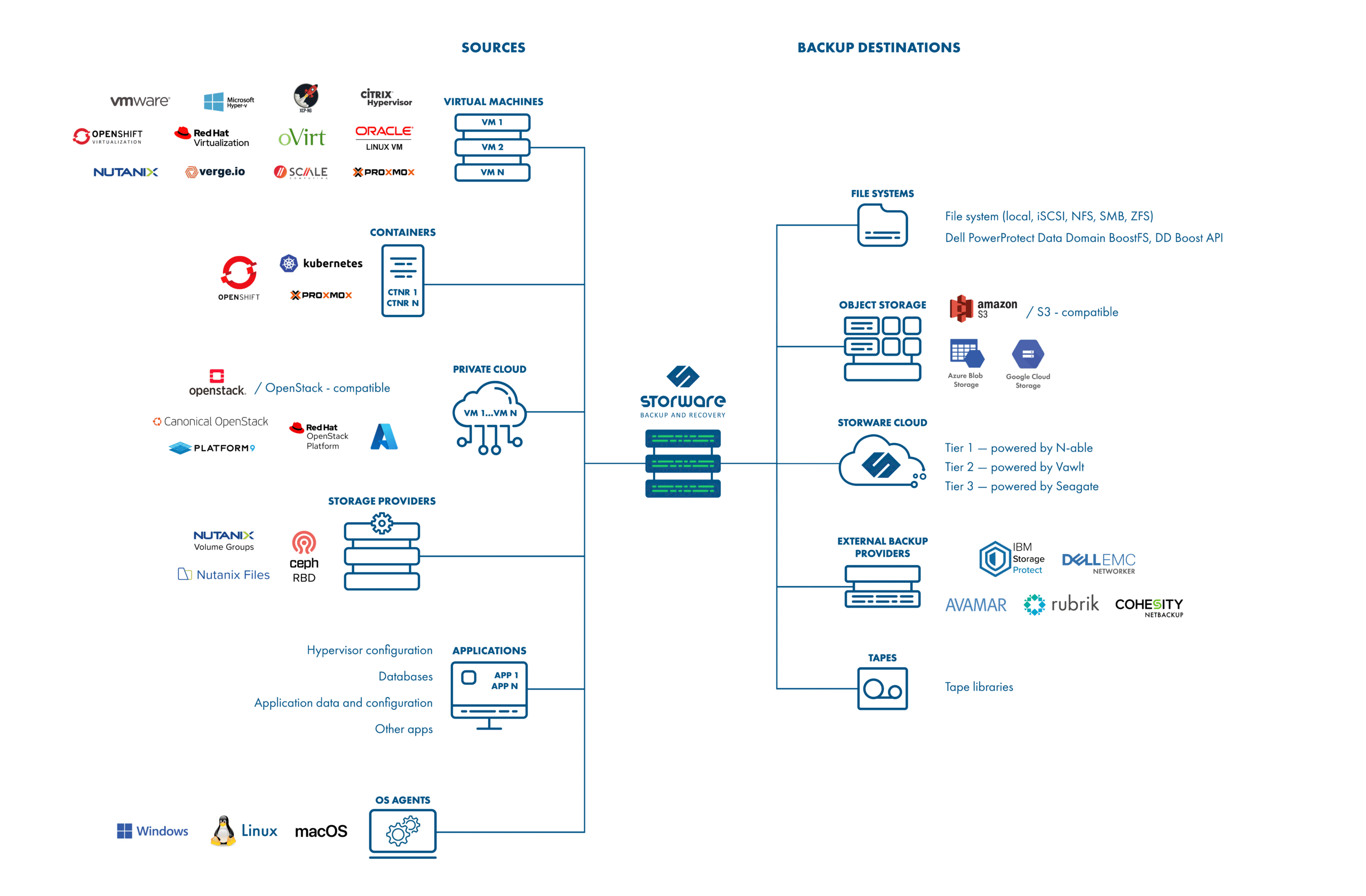
Storware 7.5 Architecture
Ready to protect your data?
Full Press Release
The official press release for Storware Backup and Recovery 7.5, including partner statements and additional context, is available for download:
Download the Storware Backup and Recovery 7.5 Press Release (PDF)
Frequently Asked Questions
Is Storware Backup and Recovery 7.5 a free upgrade for existing customers?
Yes. Version 7.5 is a standard release update available to all existing customers with an active support agreement. Upgrade documentation is available at docs.storware.eu. If you have questions about your support status, contact your account manager or reach out via storware.eu/book-meeting.
What V2V migration paths does Storware now support?
As of version 7.5, Storware supports cross-platform VM migration from VMware vSphere, Citrix Hypervisor, and XCP-ng to OpenStack. The V2V migration feature uses existing backup infrastructure — there is no separate migration appliance or additional licensing required. The target environment must be OpenStack; other destination hypervisors for V2V will follow in future releases.
Does the Platform9 integration require a separate license?
No. Storware uses a universal licensing model — a single license covers all supported hypervisors and platforms. Adding Platform9 to your protected environment does not require purchasing an additional module or platform license.
Which Nutanix AHV versions are supported with the new v4 API integration?
The v4 API integration targets current Nutanix AHV releases that have fully transitioned to the v4 API surface. Consult the Storware compatibility matrix for the specific AHV version range tested and supported in 7.5. The v3 API path remains available for environments that have not yet migrated to v4.
What does “synthetic backup” mean for Proxmox environments, and how does it differ from standard incremental backups?
A synthetic backup (sometimes called a forever-incremental or synthetic full) maintains a virtual full backup image on the destination by merging new incremental data into the existing backup chain — without re-reading the source VM. Unlike a standard incremental, which requires an occasional full backup to anchor the chain, synthetic backups eliminate the periodic full backup window entirely. For Proxmox environments with large VMs or constrained backup windows, this significantly reduces the time, storage, and network resources consumed by the backup process. In 7.5, this capability is available when using the SSH transfer strategy with a compatible synthetic backup destination.
How does the new multithreaded read support affect OpenStack backup performance?
Previously, Storware read VM disk data from OpenStack (and OpenShift Virtualization) using a single-threaded I/O path. Multithreaded reads parallelize that process, meaning that backup throughput now scales with the available I/O bandwidth rather than being bottlenecked by a single thread. In practice, organizations with large VMs or high-throughput storage backends will see the most significant improvement — in internal testing, large-volume backups showed substantial throughput gains compared to the previous release.
Ready to See 7.5 in Your Environment?
Start with a free version or explore the full feature set with a 60-day trial — no commitment required. If you’d prefer a guided walkthrough with one of our engineers, book a meeting and we’ll map the right configuration for your infrastructure.