Table of Contents
As enterprises accelerate their digital transformation initiatives, the choice between cloud infrastructure platforms becomes increasingly critical. Two names dominate conversations in IT leadership circles: OpenStack and OpenShift. While both enable cloud computing capabilities, they serve fundamentally different purposes and architectural needs. More importantly, each platform introduces unique data protection challenges that organizations must address from day one.
Understanding the differences between OpenStack and OpenShift isn’t just about selecting the right technology—it’s about ensuring your cloud infrastructure can scale securely, recover quickly from disasters, and withstand the growing threat of ransomware attacks. Let’s explore how these platforms compare and what it takes to protect the critical workloads running on them.
What is OpenStack?
OpenStack is an open-source Infrastructure-as-a-Service (IaaS) platform that enables organizations to build and manage private and public clouds. Originally launched by Rackspace and NASA in 2010, OpenStack has evolved into a mature ecosystem supported by hundreds of companies worldwide through the OpenInfra Foundation.
At its core, OpenStack provides the fundamental building blocks for cloud infrastructure: compute (Nova), storage (Cinder for block storage, Swift for object storage), and networking (Neutron). Organizations use OpenStack to create Amazon Web Services (AWS)-like environments within their own data centers, maintaining complete control over hardware, data sovereignty, and customization.
Key characteristics of OpenStack:
- Pure infrastructure layer that doesn’t dictate application architecture
- Supports multiple hypervisors including KVM-based, VMware, and Hyper-V
- Flexible storage backends from Ceph to traditional SAN arrays
- Ideal for organizations requiring maximum infrastructure control
- Commonly deployed for large-scale private clouds and telecommunications environments
OpenStack’s flexibility makes it popular among telecommunications providers, research institutions, and large enterprises with specific compliance requirements. However, this flexibility comes with complexity—managing OpenStack requires substantial infrastructure expertise and ongoing operational investment.
What is OpenShift?
Red Hat OpenShift is an enterprise Kubernetes platform that operates at the Platform-as-a-Service (PaaS) level. Built on top of Kubernetes, OpenShift provides a complete application development and deployment platform designed for containerized workloads. While Kubernetes handles container orchestration, OpenShift adds enterprise-grade security, developer tools, integrated CI/CD pipelines, and production-ready operational capabilities.
OpenShift abstracts away much of the infrastructure complexity, allowing development teams to focus on building and deploying applications rather than managing underlying infrastructure. It can run on various infrastructure layers—including OpenStack, VMware, bare metal, or public clouds like AWS and Azure.
Key characteristics of OpenShift:
- Container-native platform built on Kubernetes
- Integrated developer experience with built-in tools and workflows
- Enterprise security features including SELinux, role-based access control, and network policies
- Multi-cloud and hybrid cloud deployment capabilities
- Automated application scaling and self-healing capabilities
OpenShift has become the platform of choice for organizations embracing microservices architecture, DevOps practices, and cloud-native application development. Financial services, healthcare providers, and retail organizations frequently select OpenShift for its security features and developer productivity enhancements.
OpenStack vs OpenShift: The Core Differences
Understanding where these platforms differ helps clarify which solution aligns with your organization’s needs:
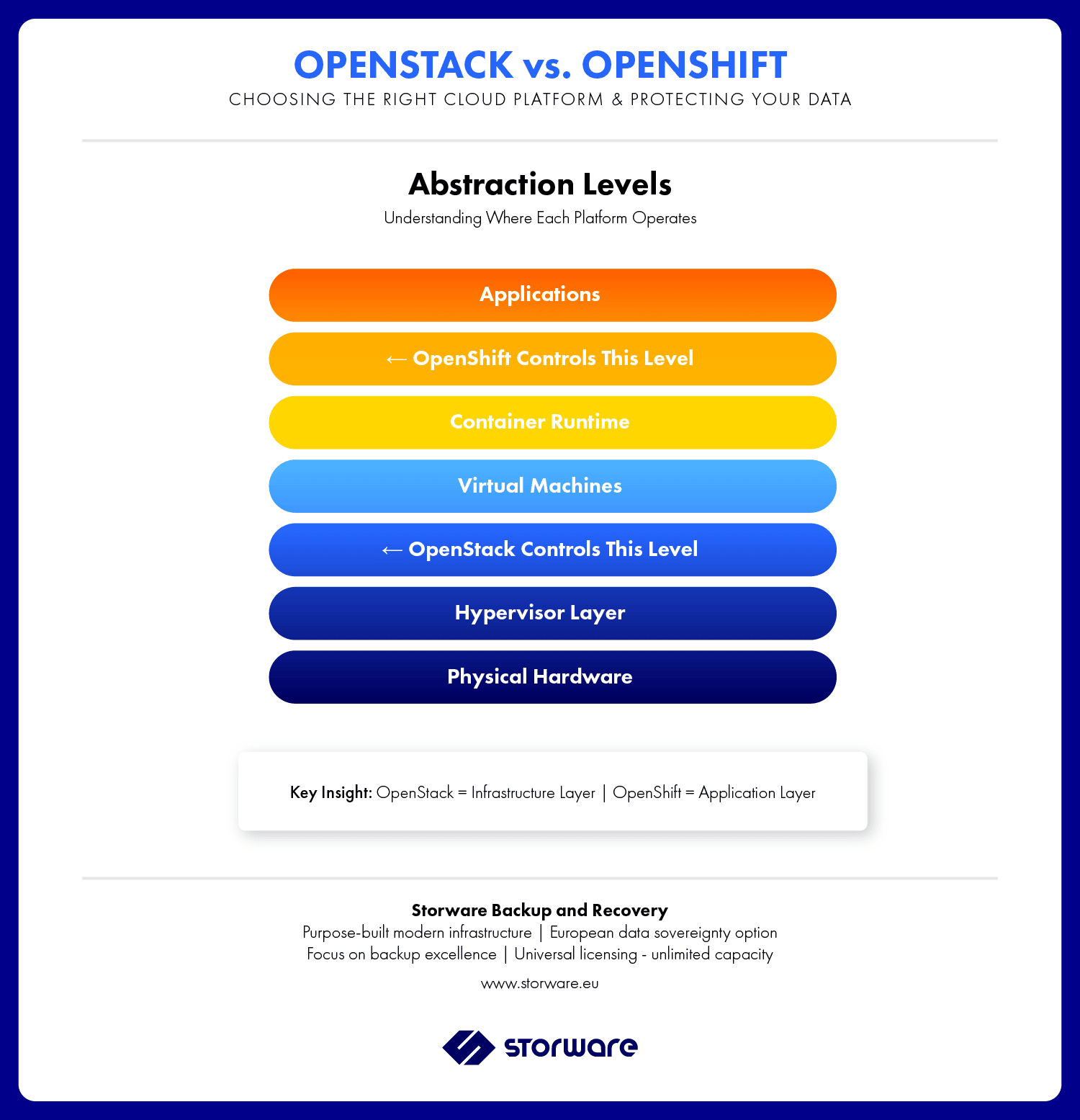
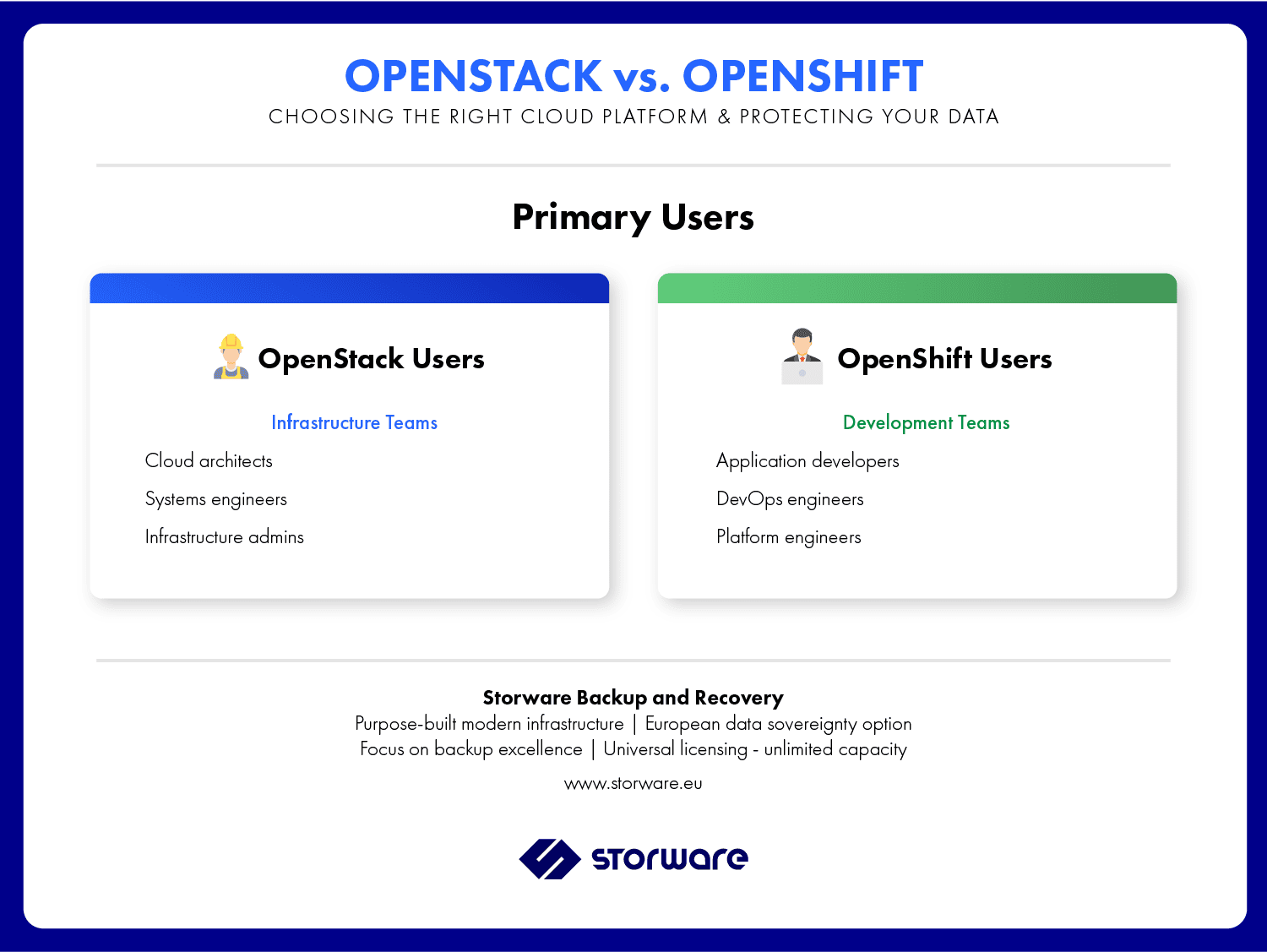
Infrastructure vs Platform: OpenStack provides infrastructure building blocks (virtual machines, networks, storage), while OpenShift provides an application platform (container orchestration, application deployment, developer tools). Think of OpenStack as providing the land to build on, while OpenShift provides a pre-built development environment.
Abstraction Level: OpenStack requires you to manage virtual machines, storage volumes, and network configurations. OpenShift abstracts these concerns, letting you deploy applications without worrying about the underlying VMs or infrastructure details.
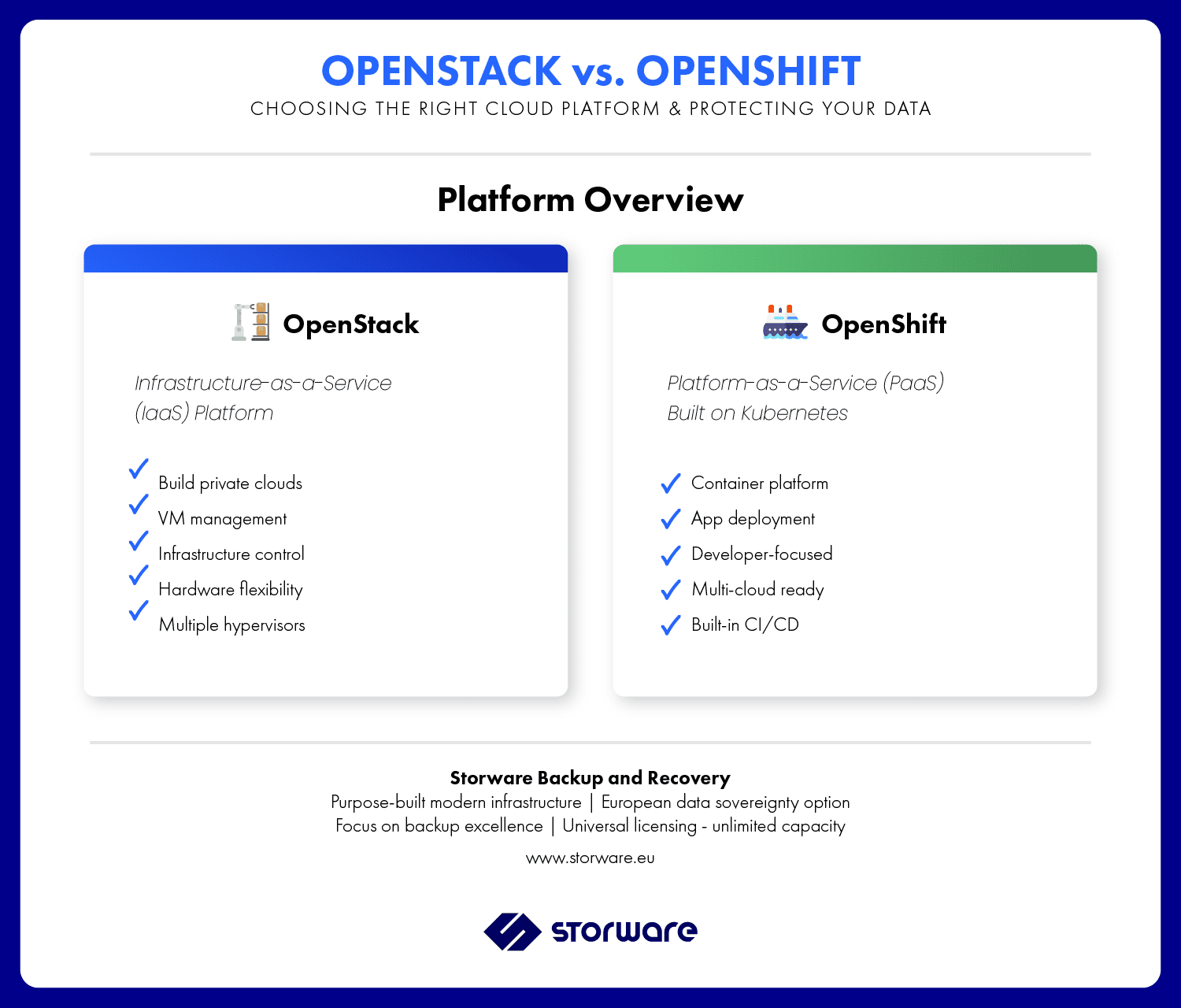
Primary Users: OpenStack serves infrastructure teams and cloud architects who need granular control. OpenShift targets application developers and DevOps teams who want to deploy applications quickly without infrastructure concerns.
Deployment Model: OpenStack typically forms the foundation of a private cloud strategy. OpenShift can run anywhere—on-premises, in public clouds, or in hybrid configurations—making it inherently more portable.
Technology Stack: OpenStack manages traditional workloads (VMs) and newer containerized applications. OpenShift focuses exclusively on containerized, cloud-native applications running on Kubernetes.
Complexity vs Convenience: OpenStack offers maximum flexibility and control at the cost of operational complexity. OpenShift sacrifices some low-level control for simplified application deployment and management.
Use Cases: When to Choose OpenStack vs OpenShift
Choose OpenStack when:
- Building large-scale private cloud infrastructure with specific hardware requirements
- Requiring maximum control over infrastructure components and configurations
- Supporting mixed workloads including traditional VMs and legacy applications
- Operating in highly regulated industries with strict data sovereignty requirements
- Running telecommunications workloads or network functions virtualization (NFV)
- Needing infrastructure that supports multiple hypervisors and storage backends
Organizations like CERN, Walmart, and numerous telecommunications providers run massive OpenStack deployments to maintain infrastructure control while achieving cloud economics.
Choose OpenShift when:
- Developing cloud-native applications using microservices architecture
- Requiring consistent application deployment across multiple cloud environments
- Prioritizing developer productivity and rapid application iteration
- Implementing DevOps and continuous delivery practices
- Needing enterprise Kubernetes with integrated security and compliance features
- Running containerized applications that require automatic scaling and orchestration
Banks, insurance companies, and digital-first businesses frequently select OpenShift to accelerate application modernization and improve time-to-market.
The Data Protection Challenge: Why Backup Matters for Both Platforms
Regardless of whether you choose OpenStack or OpenShift, one critical consideration remains constant: comprehensive data protection. Both platforms introduce unique backup and recovery challenges that organizations often underestimate during initial deployment.
For OpenStack environments, the challenges include:
- Protecting diverse storage backends (Ceph, Cinder volumes, Swift objects)
- Backing up VM configurations, metadata, and persistent storage
- Ensuring consistency across distributed storage systems
- Managing backup at scale with potentially thousands of virtual machines
- Maintaining data sovereignty and compliance requirements
- Coordinating backups across multiple OpenStack components
For OpenShift and Kubernetes environments, the challenges differ:
- Protecting stateful applications and persistent volumes
- Backing up namespace configurations, ConfigMaps, and Secrets
- Ensuring application-consistent backups for databases running in containers
- Managing etcd cluster data and Kubernetes API objects
- Protecting multi-tenant environments with appropriate isolation
- Coordinating backup across dynamic, ephemeral container workloads
Many organizations mistakenly assume that high availability features in these platforms eliminate the need for backup. However, high availability protects against infrastructure failures—not data corruption, accidental deletion, ransomware attacks, or compliance requirements for long-term data retention.
OpenStack Backup and Recovery: Requirements and Best Practices
Implementing effective OpenStack backup requires understanding the platform’s architecture and storage options. A comprehensive OpenStack backup strategy must address multiple data types and components:
Virtual Machine Backup: Protecting VMs running on OpenStack requires more than simple snapshots. Production-grade backup solutions must capture VM state, configuration metadata, and attached storage volumes while maintaining application consistency. Organizations running databases or transactional applications on OpenStack need backup solutions that can coordinate with applications to ensure recoverability.
Ceph Storage Protection: Many OpenStack deployments use Ceph for block and object storage. Backing up Ceph-based storage requires specialized knowledge of Ceph’s architecture, including RBD (RADOS Block Device) snapshots and object storage protection. Traditional backup approaches often fail to efficiently handle Ceph’s distributed nature.
Multi-Tenancy Considerations: OpenStack’s project-based architecture requires backup solutions that respect tenant boundaries, enforce role-based access controls, and enable self-service recovery capabilities for different teams and departments.
Disaster Recovery Planning: Beyond backup, organizations need robust disaster recovery capabilities including cross-region replication, site failover procedures, and regular recovery testing. OpenStack’s distributed architecture makes DR planning complex but essential.
OpenShift Backup and Recovery: Kubernetes-Native Protection
OpenShift and Kubernetes introduce fundamentally different backup requirements compared to traditional virtualization platforms. Container platforms are dynamic, with applications and infrastructure constantly changing. Effective OpenShift backup must address this dynamic nature while ensuring complete recoverability.
Persistent Volume Protection: While containers themselves are ephemeral, stateful applications require persistent volumes that must be protected. OpenShift backup solutions need to understand storage classes, volume types, and application-storage relationships to ensure consistent backups.
Namespace and Configuration Backup: Beyond data volumes, OpenShift environments require protection of namespace configurations, custom resource definitions (CRDs), application deployments, services, routes, and security policies. Losing these configurations can be as devastating as losing application data.
Application-Aware Backup: Modern applications running on OpenShift often consist of multiple microservices, databases, message queues, and configuration elements. Effective backup requires understanding application topology and ensuring all components are backed up consistently.
etcd Cluster Protection: OpenShift’s control plane relies on etcd for cluster state and configuration. Protecting etcd is critical for cluster recovery, yet many organizations overlook this essential component.

Ransomware Resilience: Protecting Cloud Infrastructure from Modern Threats
Ransomware attacks have evolved from encrypting individual workstations to targeting entire infrastructure platforms. Recent attacks demonstrate that sophisticated threat actors specifically target cloud environments, virtualization platforms, and backup infrastructure.
Both OpenStack and OpenShift environments require ransomware resilience strategies that go beyond traditional security measures:
Immutable Backup Storage: Creating backups isn’t enough—those backups must be protected from encryption or deletion by ransomware. Immutable backup storage prevents any modification or deletion of backup data, even by privileged administrators. This ensures that even if ransomware compromises your production environment, recovery data remains intact.
Air-Gapped Backups: Physical or logical isolation of backup copies provides an additional layer of protection. Air-gapped backups remain unreachable from production networks, preventing ransomware from propagating to backup infrastructure.
Granular and full workload recovery with minimized downtime: When ransomware strikes, recovery speed becomes critical. Organizations need backup solutions that can quickly restore entire environments—virtual machines, containers, configurations, and data—to minimize downtime and business impact.
Frequent incremental and snapshot-based backups to minimize RPO: Traditional daily backups leave organizations vulnerable to hours or days of data loss. Near-continuous protection minimizes recovery point objectives (RPO) and ensures business continuity even after devastating attacks.
How Storware Protects OpenStack and OpenShift Environments
Storware provides comprehensive, agentless backup and recovery solutions specifically designed for modern cloud infrastructure platforms. Unlike traditional backup vendors that retrofitted VM backup tools for cloud environments, Storware built its Backup and Recovery solution from the ground up to address the unique requirements of OpenStack, OpenShift, and other cloud-native platforms.
Unified Protection for Both Platforms: Organizations running both OpenStack and OpenShift don’t need separate backup solutions. Storware provides a single platform that protects both environments, simplifying management, reducing costs, and ensuring consistent data protection policies across your infrastructure.
Agentless Architecture: Storware’s agentless approach eliminates the operational overhead of managing backup agents across thousands of VMs or containers. The solution integrates directly with platform APIs, reducing performance impact and simplifying deployment. This architecture is particularly valuable in dynamic environments where VMs and containers are constantly created and destroyed.
OpenStack-Native Integration: For OpenStack environments, Storware integrates natively with Nova, Cinder, and popular storage backends including Ceph, providing efficient, crash-consistent backups. The solution supports multiple hypervisors (KVM-based, VMware, Hyper-V) and can protect virtual machines regardless of the underlying infrastructure.
Kubernetes and OpenShift Expertise: Storware understands the complexities of container platform backup. The solution protects persistent volumes, namespace configurations, Kubernetes objects, and application data while respecting OpenShift’s security policies and multi-tenant architecture.
Immutable Backup Storage: Storware enables organizations to leverage immutable storage targets, creating ransomware-resilient backup copies that cannot be encrypted, modified, or deleted. This includes integration with cloud storage providers offering immutability features and on-premises storage solutions.
Flexible Recovery Options: Whether recovering individual files, entire VMs, specific containers, or complete namespace configurations, Storware provides granular recovery capabilities that minimize downtime and data loss. Organizations can perform full environment restoration or selective recovery based on specific needs.
Cost-Effective Licensing: We offer multiple licensing models, you choose what best fits your needs. This pricing model eliminates unexpected costs as your infrastructure grows and provides predictable budget planning.
Competitive Advantages: Why Organizations Choose Storware
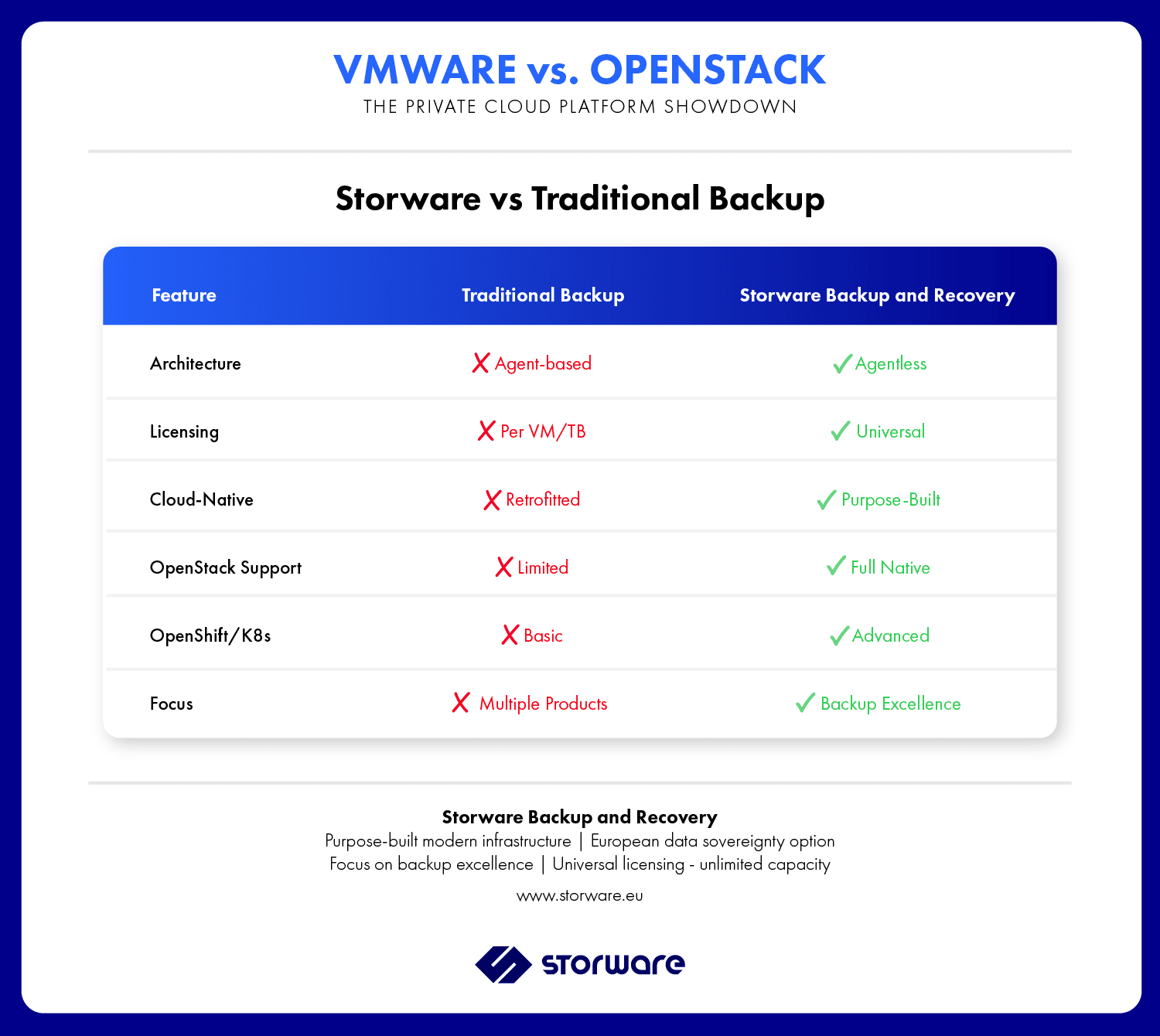
The backup and recovery market includes established vendors like Veeam, Commvault, and Rubrik. However, these solutions were designed primarily for traditional virtualization platforms and often struggle with cloud-native environments. Storware’s purpose-built approach provides distinct advantages:
True Cloud-Native Architecture: While legacy vendors added OpenStack and Kubernetes support as afterthoughts, Storware designed its solution specifically for these platforms. This results in better performance, more reliable backups, and simpler operations.
Agentless, platform-integrated protection without per-VM or per-container agents: Competitors requiring agents on every VM or container introduce operational complexity, performance overhead, and licensing costs. Storware’s agentless architecture eliminates these concerns entirely.
Predictable Licensing: Many backup vendors use complex licensing models that charge per VM, per terabyte, per feature, or some combination thereof. These models become expensive and unpredictable as infrastructure grows. Storware’s universal licensing provides unlimited capacity and features at a fixed cost.
Focus on Core Competencies: While some vendors have expanded into adjacent markets (security, monitoring, management), Storware remains focused exclusively on backup and recovery excellence. This focus results in more robust data protection capabilities and faster innovation in core backup functionality.
European Data Sovereignty: For organizations with European operations or GDPR compliance requirements, Storware’s Polish headquarters and European focus provide an alternative to US-based vendors, addressing data sovereignty concerns.

Making the Right Choice: Platform Selection and Data Protection
Choosing between OpenStack and OpenShift depends on your organization’s specific needs, existing infrastructure, and application strategy. OpenStack provides maximum infrastructure control for organizations requiring customization and flexibility. OpenShift accelerates application development for organizations embracing cloud-native architectures.
However, regardless of which platform you choose—or if you deploy both—comprehensive data protection must be part of your initial planning. The cost of data loss, whether from hardware failure, human error, or ransomware attacks, far exceeds the investment in proper backup infrastructure.
Organizations implementing OpenStack should evaluate backup solutions based on their ability to efficiently protect diverse workloads, integrate with Ceph and other storage backends, and scale to thousands of VMs. OpenShift deployments require backup solutions that understand Kubernetes architecture, protect both data and configurations, and provide rapid recovery capabilities.
Storware’s purpose-built solutions address both platforms with a unified approach that simplifies operations, reduces costs, and provides enterprise-grade data protection. The agentless architecture, universal licensing, and ransomware resilience features make Storware an ideal choice for organizations deploying modern cloud infrastructure.
Conclusion: Protecting Your Cloud Investment
OpenStack and OpenShift represent powerful approaches to cloud infrastructure, each excelling in different use cases. OpenStack provides infrastructure building blocks for organizations requiring maximum control, while OpenShift delivers an application platform that accelerates cloud-native development.
The critical factor both platforms share is the need for comprehensive backup and recovery capabilities. High availability features protect against infrastructure failures but cannot address data corruption, accidental deletion, or ransomware attacks. Organizations must implement dedicated backup solutions that understand the unique architectures of these platforms and provide reliable, efficient data protection.
As you evaluate OpenStack versus OpenShift for your organization, ensure data protection is part of the conversation from day one. The right backup solution—one designed specifically for modern cloud platforms—protects your infrastructure investment, ensures business continuity, and provides the ransomware resilience required in today’s threat landscape.
Storware’s Backup and Recovery solution delivers this protection for both OpenStack and OpenShift environments, combining agentless architecture, universal licensing, and purpose-built cloud-native capabilities. Organizations choosing Storware gain a reliable partner focused exclusively on backup excellence, ensuring their cloud infrastructure remains protected, recoverable, and resilient against any data loss scenario.