Table of Contents
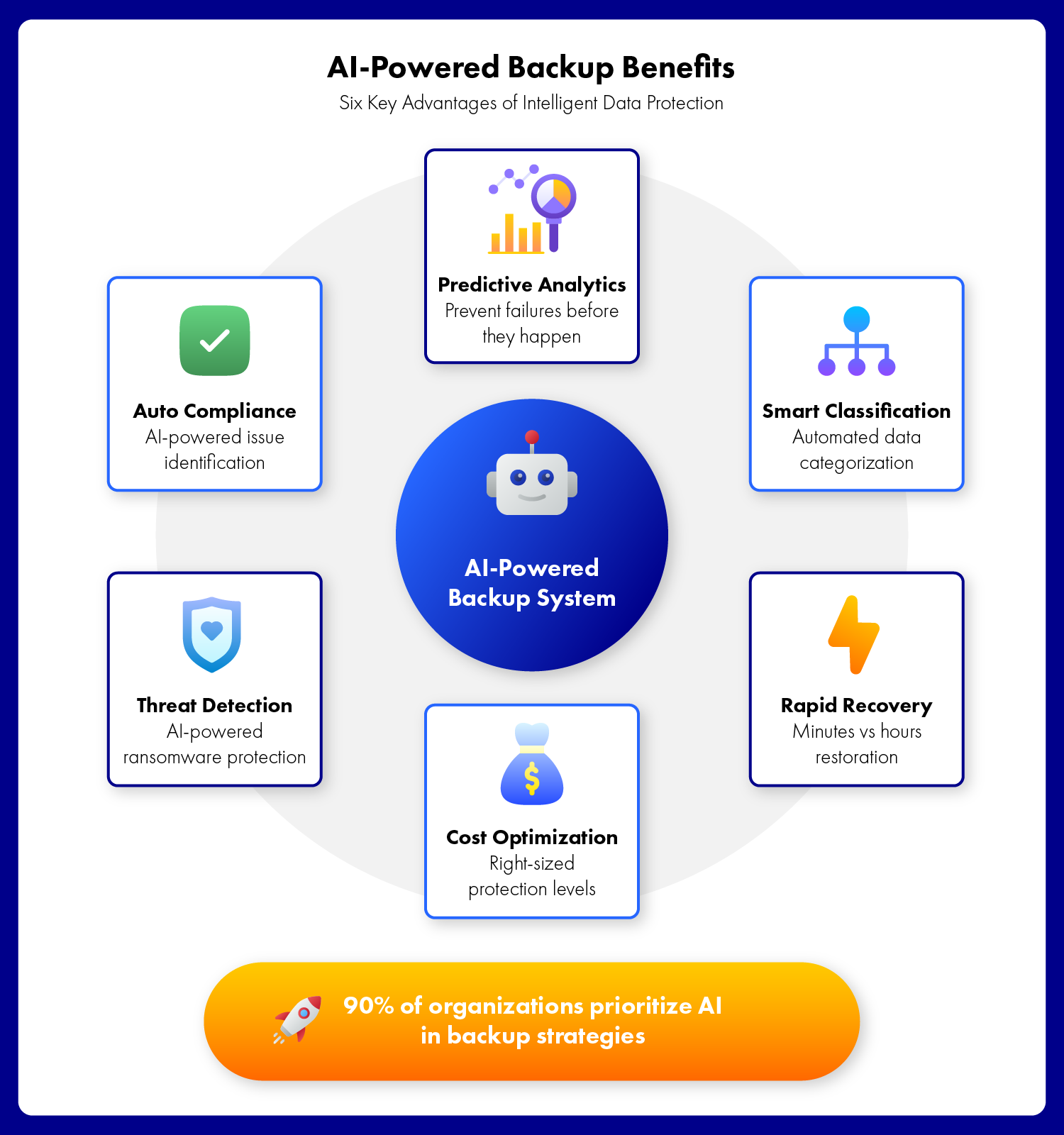
Artificial Intelligence (AI) is transforming IT infrastructure management, with backup and disaster recovery (DR) solutions at the forefront of this technological evolution. As organizations generate exponentially more data, traditional backup methods are proving insufficient for modern business continuity requirements.
Data protection has evolved from simple file copying to sophisticated, intelligent systems that can predict failures, optimize storage, and automate recovery processes. This shift represents a fundamental change in how businesses approach business continuity planning and disaster recovery strategies.
Market Demand: What the Research Shows
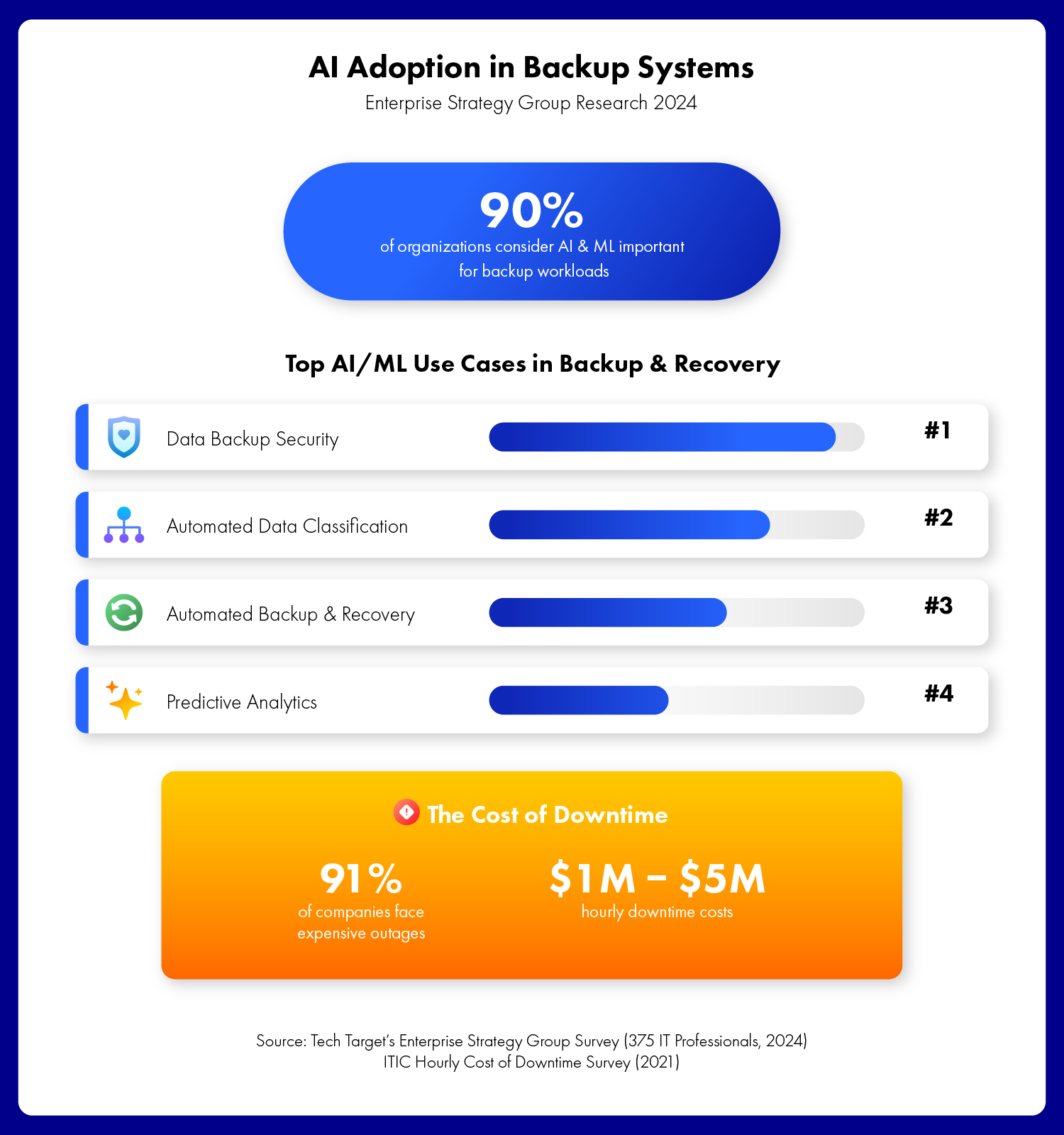
Recent Enterprise Strategy Group research among North American private companies and public organizations reveals compelling insights: over 90% of respondents consider AI and machine learning (ML) important, very important, or even critical for backup and disaster recovery operations.
The study participants most frequently identify cybersecurity as the greatest benefit of integrating AI/ML with backup systems and data recovery (21%), followed by:
- Automated data classification (13%)
- Backup automation and disaster recovery (11%)
- Data loss prevention (11%)
- Data quality assurance (8%)
Key AI/ML Capabilities in Backup Solutions
According to the Enterprise Strategy Group study, organizations prioritize these AI-driven capabilities:
- Fast data recovery (55%)
- Automatic RPO/RTO parameter selection (46%)
- Automated failover between locations (45%-43%)
- Backup frequency optimization (44%)
Customer Priorities: Speed and Automation
Backup solution providers are beginning to implement AI/ML mechanisms, though this is still largely market exploration. Customers generally reject technological fireworks – what matters is minimizing downtime and automating processes.
Automation solves industry problems in two ways: it accelerates critical processes while eliminating the risk of human error. Simultaneously, there’s growing demand for protecting hybrid environments against unpredictable failure scenarios.
Defining Key Terms
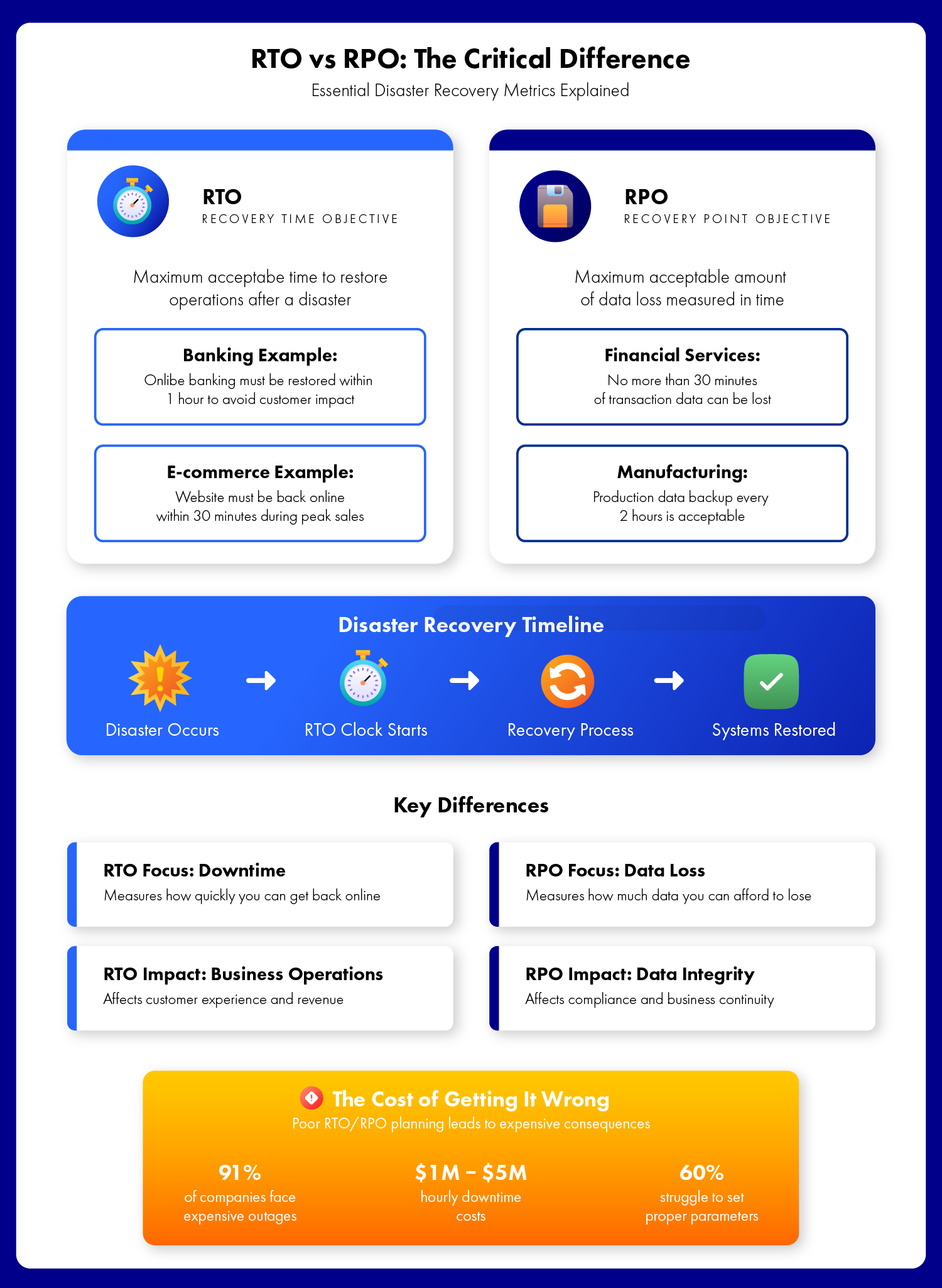
- RTO (Recovery Time Objective): The maximum acceptable time to restore systems after a disaster
- RPO (Recovery Point Objective): The maximum acceptable data loss measured in time
- Backup automation: The process of scheduling and executing data backups without manual intervention
- Disaster recovery planning: A comprehensive strategy for restoring IT infrastructure after a catastrophic event
The RTO and RPO Challenge: Who Bears Responsibility?
The list of expectations from ESG study participants seems predictable but reveals critical industry problems. Organizations desperately seek solutions for their most pressing challenges, with dramatic difficulties in determining RTO (Recovery Time Objective) and RPO (Recovery Point Objective) indicators serving as perfect examples.
According to Storware observations, 60% of enterprises cannot properly determine these parameters. Mindless copying of values from publicly available sources dominates, without analyzing business needs. This superficial approach leads to serious consequences.
The Two Major Pitfalls
First pitfall: Budget waste on inflated protection levels. Example: Setting RPO at 15 minutes for a system used once weekly.
Second pitfall: Dangerous risk tolerance. Overly liberal RTO/RPO parameters lead to:
- Extended system failures
- Loss of critical business data
- Losses counted in hundreds of thousands of dollars per hour of downtime
When backup systems gain autonomous parameter-setting capabilities, responsibility automatically shifts to the vendor. For clients, this represents a breakthrough change: an end to exhausting analyses and the risk of catastrophic errors.
However, this solution contains a trap. RPO/RTO decisions must consider an organization’s unique DNA: business specifics, regulatory requirements, and corporate culture. Can an algorithm truly understand that for a bank, a 5-minute outage is a financial catastrophe, while for a small shop it’s merely a minor inconvenience?
Intelligence Requires Data: The Foundation of AI-Driven Protection
Achieving this ambitious goal requires in-depth analysis and access to massive datasets. Key operations include:
- Continuous Business Monitoring: AI continuously analyzes transactions, processes, and dependencies, assigning each system business weight based on actual usage and operational impact in real-time.
- Complex System Interdependency Analysis: Equally critical is examining complicated networks of system relationships, identifying key single points of failure and dangerous dependency chains that can instantly paralyze entire infrastructure.
Systems that learn from every transaction understand business context and automatically adjust protection levels to actual organizational priorities.
From Log Analysis to Predictive Data Protection
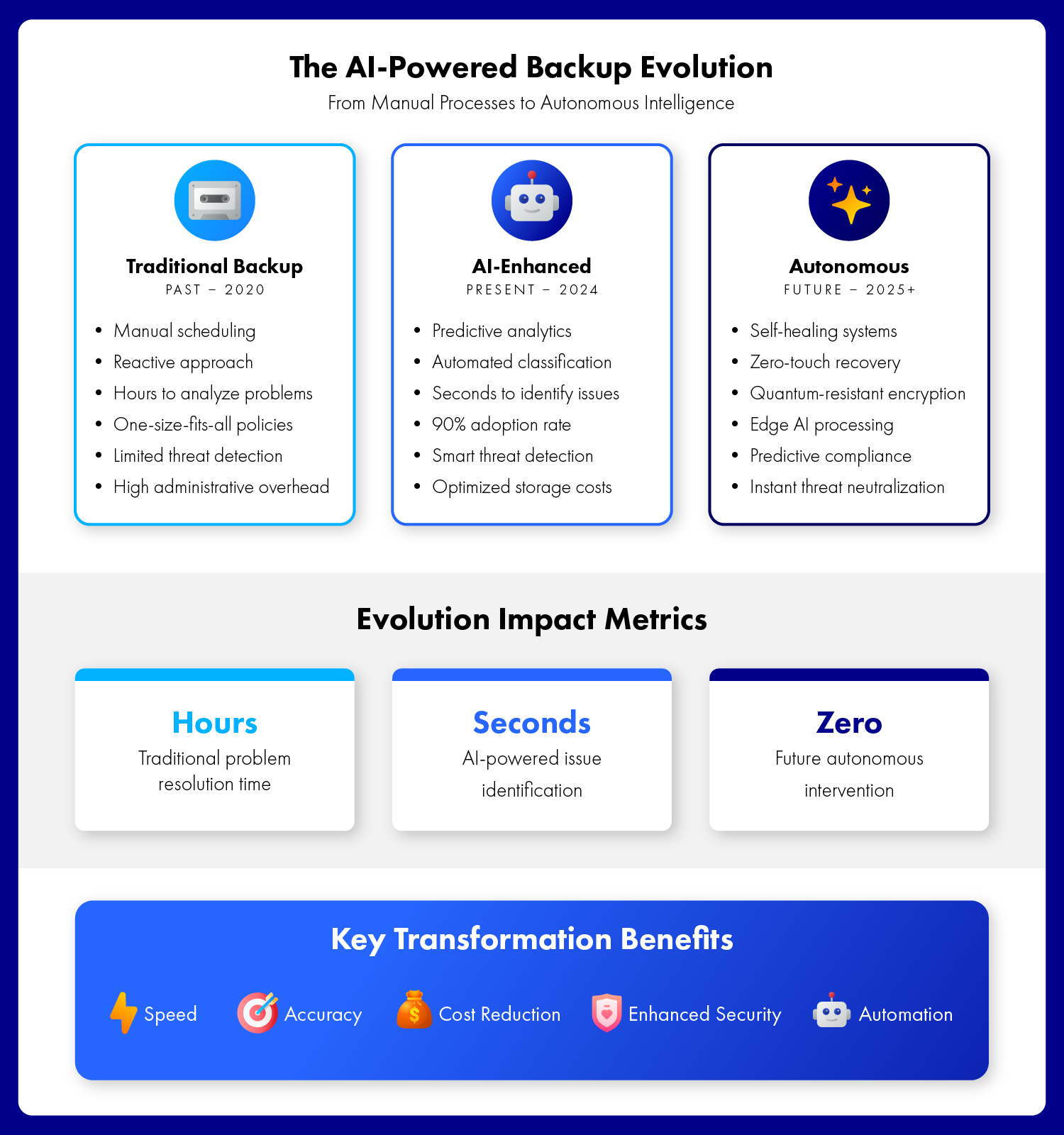
The greatest AI potential lies in predictive analytics for problems and proactive backup management and technical support. This approach represents a paradigm shift in thinking about data security and IT infrastructure maintenance. Traditional technical support relies on a reactive model: problems occur, customers report incidents, teams analyze situations, then find solutions. This process can take hours, sometimes days.
AI-based systems can operate completely differently. Intelligent observability platforms continuously monitor thousands of instances worldwide, securely collecting event information, analyzing patterns, and learning from each incident. This means transitioning from reacting to problems to predicting and preventing them.
The best example of AI revolution is system log analysis. Previously, administrators had to spend up to 2 hours analyzing logs to understand problem causes. Intelligent AI agents can perform the same work in seconds, correlate different data sources, and present the problem’s essence in understandable form.
User Benefits of AI-Based Backup Systems
From a user perspective, AI-based backup systems offer:
- Minimized downtime: By predicting failures, systems can take preventive action before problems impact business operations
- Cost optimization: Through intelligent resource management, systems automatically adjust protection levels to actual needs
- Improved security: Proactive monitoring enables threat detection in the earliest stages
Imagine an ideal world where customers contacting intelligent backup and DR systems don’t wait for help. They immediately receive information with best practices and specific action guidelines. Alternatively, tickets are automatically created with solutions for problems that have likely already occurred or will soon occur.
AI in Backup: Revolution or Complication?
Does artificial intelligence truly deliver promised savings? Numerous cases show this isn’t necessarily true. The same question arises with AI solutions for data protection.
Consider one vendor’s revolutionary concept: AI mechanisms analyze data directly from backup copies. Users ask questions – systems immediately respond. Traditional approaches required placing files in NAS directories and creating dedicated content processing applications. New solutions allow skipping these steps, but will they actually work?
Backup tools sometimes use artificial intelligence for real-time data type analysis, identifying optimal storage options for each information type. This enables separating hot, warm, and cold storage, both locally and in cloud environments, maximizing the performance-to-cost ratio.
Artificial intelligence can also ensure compliance monitoring and reporting to ensure organizations meet regulatory requirements. It can identify areas where organizations are non-compliant, enabling problem resolution before penalties. This compliance is particularly important for data sovereignty regulations and privacy concerns.
Current Market Trends and Technologies
- Edge Computing Integration: Modern AI-powered backup solutions increasingly integrate with edge computing environments, enabling faster local processing and reduced bandwidth requirements for cloud backup operations.
- Zero Trust Security Models: AI systems now incorporate zero trust architecture principles, continuously verifying user access and data integrity throughout the backup and recovery process.
- Ransomware Protection: Advanced ransomware detection capabilities use machine learning to identify unusual file patterns and automatically isolate infected systems before widespread damage occurs.
Best Practices for AI-Powered Backup Implementation
1. Data Governance Framework: Establish clear data governance policies that define how AI systems access, analyze, and protect sensitive information during backup operations.
2. Testing and Validation: Regular disaster recovery testing remains crucial, even with AI automation. Validate that recovery procedures work correctly across different failure scenarios.
3. Hybrid Approach: Combine AI automation with human oversight for critical decisions, especially regarding business continuity and data retention policies.
Conclusion: Balancing Innovation with Practicality
The functionalities mentioned when applied to backup and DR systems may prove useful from some users’ perspectives, but multiplying features sometimes complicates system work rather than simplifying it.
The key to successful AI implementation in data protection lies in focusing on genuine business value rather than technological novelty. Organizations should prioritize solutions that demonstrably reduce recovery times, improve data integrity, and enhance operational efficiency while maintaining the simplicity that IT teams require.
As AI continues to evolve, the most successful backup and disaster recovery solutions will be those that seamlessly integrate intelligence with usability, providing powerful capabilities without overwhelming users with unnecessary complexity.
Research and Sources
- TechTarget’s Enterprise Strategy Group Research Report: Reinventing Backup and Recovery with AI and ML – July 2024
- TechTarget Analysis: GenAI lags traditional AI and ML for enterprise data backup
- ESG Industry Brief: AI-driven Backup and Recovery: Which Industries Fully Commit and Which Tread More Carefully