

VMware to OpenStack Migration Without the Lock-In
Broadcom changed the math on VMware. Migrate vSphere workloads to OpenStack using the backups you already run — one platform protects both sides before, during, and after the move, rollback is a restore to VMware, and the whole thing runs under EU jurisdiction.

Key Highlights

Your backups are the migration engine
Existing vSphere backups restore straight into OpenStack. No separate migration product to license, no virt-v2v pipeline to build and maintain.

No protection gap across the exit
The same platform protects vSphere before the move and OpenStack after. Coverage never pauses for the project window.

One universal license, both sides
vSphere source and OpenStack target under a single SKU — no per-VM or per-socket migration fees, no feature tier to unlock.

EU-based alternative to US vendors
Warsaw headquarters, EU control plane, engineering, and support. A VMware exit that can also be a US-jurisdiction exit.
VMware-to-OpenStack migration, built into the platform
Backup-as-migration for vSphere → OpenStack
Cross-hypervisor restore (introduced in v7.1) restores VMware backups directly into OpenStack — Red Hat OpenStack Platform, Canonical OpenStack, Virtuozzo Infrastructure, OpenMetal, Platform9, and community deployments.
Agentless vSphere source
vCenter is added as a Virtualization Provider through its API — nothing installed inside guests. ESXi 7.0 and 8.0 are supported as backup and V2V migration sources.
Disk conversion and driver injection built in
VMDK is converted to QCOW2/RAW with guest driver injection and OpenStack instance creation handled inside the restore. No manual qemu-img, no intermediary conversion appliance.
Cinder-aware target placement
The migration wizard maps storage to Cinder volumes, assigns the target network, and sets the instance flavor — VMware resources mapped to OpenStack equivalents in one flow.
Batched, policy-driven cutover
Full and incremental backups with CBT keep each cohort current. Batch by workload profile — lift-and-shift, refactor, or special-handling — instead of moving everything at once.
Continued OpenStack protection after cutover
The same policies protect the migrated workloads: IsoLayer air-gap, WORM immutability, AES encryption, Keycloak MFA, RBAC, and Recovery Plans — no second tool, no re-architecture.
Native OpenStack integration in steady state
Agentless protection via Keystone, with Horizon and Skyline UI integration, multi-tenancy, and RBAC for the new environment.
Technology partners






Broadcom changed the VMware equation
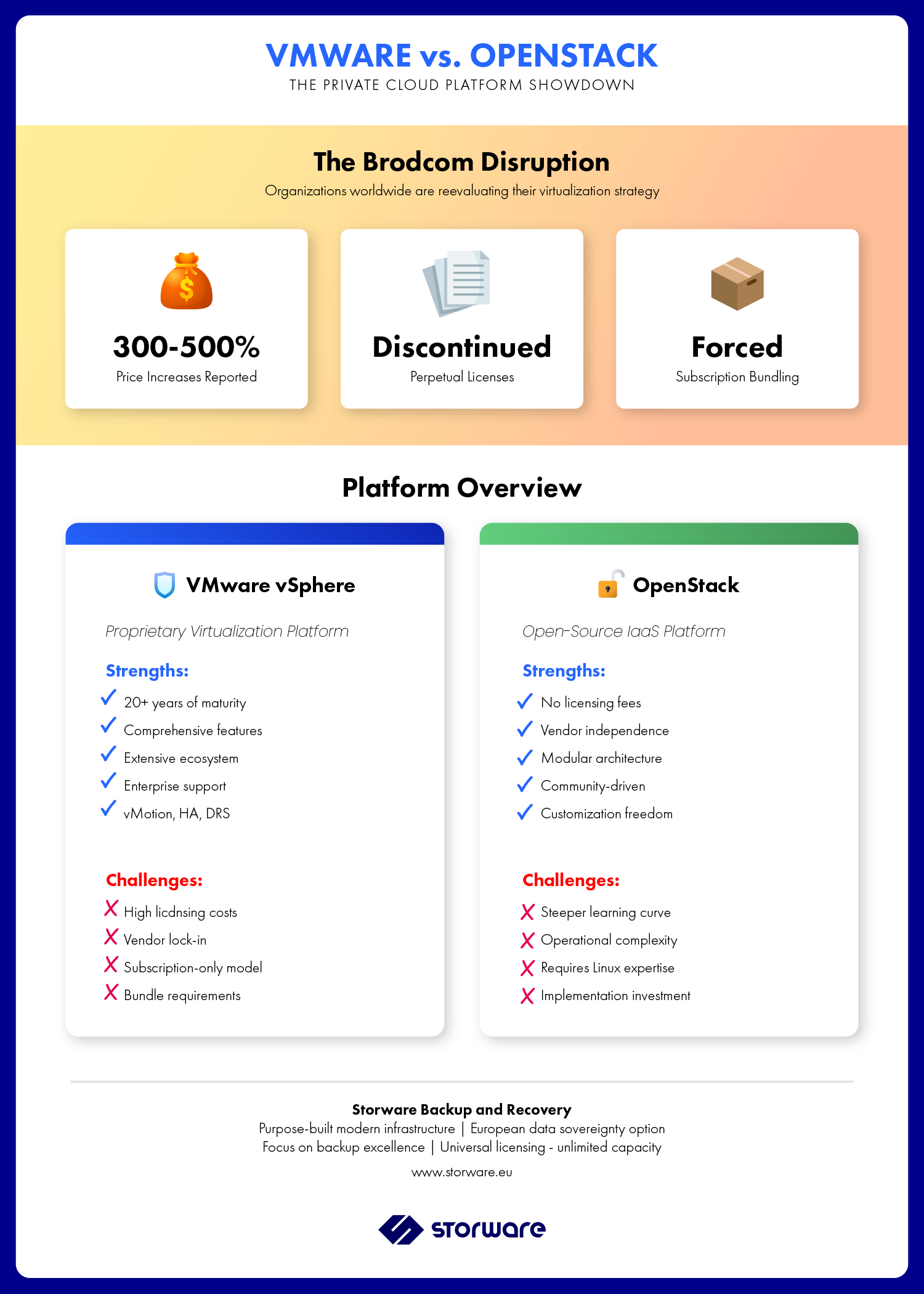
Subscription-only licensing
Perpetual VMware licenses ended in early 2024. The catalogue collapsed from 160+ SKUs to four bundles (VCF, VVF, vSphere Standard, vSphere Enterprise Plus) — all subscription, on fixed terms.
The 72-core minimum
Since April 10, 2025, the minimum purchase is 72 cores per order line, up from 16. Smaller servers, edge sites, and compact deployments now pay for capacity that doesn't physically exist.
Cost increases
Reported price changes run 150–1,500% depending on customer profile, with the sharpest impact on mid-market shops previously on the discontinued vSphere Essentials Plus.
The renewal-date squeeze
A 20% late-renewal penalty means your migration window is set by your renewal anniversary, not your project plan. Gartner has indicated Broadcom could lose more than a third of VMware customers and workloads within three years.
Leaving VMware is also a chance to leave US-jurisdiction risk.
For European organizations, the data protection vendor you run alongside OpenStack is a sovereignty decision, not just a technical one. Storware's control plane, support, and engineering are EU-based.

Data residency (GDPR)
GDPR covers the backup metadata catalogue, not just the workload payload. A control plane operated under US jurisdiction creates a measurable compliance question. Storware's is EU-based by design.
Supply-chain rules (NIS2 & DORA)
NIS2 (in force from October 2024) and DORA (applicable from January 2025) require demonstrable supply-chain and ICT third-party resilience — including your backup vendor. Storware is used by EU public-sector and regulated-industry customers under both.
CLOUD Act exposure
US-headquartered vendors can be compelled to produce data held anywhere, creating documented tension with GDPR Article 48. Storware sits outside that extraterritorial jurisdiction.
See a VMware-to-OpenStack migration run end to end
Watch Storware Backup and Recovery take a vSphere VM from backup to a running, protected OpenStack instance — disk conversion, resource mapping, and validation included.
How does Storware migrate VMware VMs to OpenStack?
Storware uses backup-as-migration. Your existing VMware backups are restored directly into OpenStack — the restore is the migration. Disk format conversion, driver injection, and OpenStack instance creation happen inside that restore. There’s no separate migration appliance.
Which VMware and OpenStack versions are supported?
VMware vSphere with ESXi 7.0 and 8.0, as both backup and V2V migration sources. Targets include Red Hat OpenStack Platform, Canonical OpenStack, Virtuozzo Infrastructure, OpenMetal, Platform9, and community OpenStack deployments.
Do I need a separate migration tool?
No. Backup, recovery, and V2V migration run in one platform under one license. The backup catalogue is the migration source — nothing extra to license, learn, or troubleshoot.
Do I need to install agents?
No. vCenter is connected through its API and OpenStack through Keystone — both agentless. Nothing is installed inside the guests for backup or migration.
Can I migrate Windows VMs to OpenStack?
Yes — Windows 10/11 Pro and Windows Server 2019/2022 are supported. Windows VMs must be powered off before the backup used as the V2V source. Instances with encrypted system drives, TPM, or multi-boot configurations aren’t supported.
How long does a VMware-to-OpenStack migration take?
It depends on VM count, workload complexity, and OpenStack distribution. A typical 100-VM cohort can reach validation in two to four weeks once policies and Virtualization Providers are configured; larger estates are batched. A scoped assessment can give a realistic timeline for your environment.
Is Storware subject to the US CLOUD Act?
No. Storware is headquartered in Warsaw, Poland, with EU-based engineering, support, and control-plane operations — outside the extraterritorial jurisdiction the CLOUD Act creates for US-headquartered vendors.