

Back Up VMware. Recover to OpenStack.
Protect vSphere workloads and recover them directly into OpenStack from the backups you already run. One platform protects both environments, under one license and EU jurisdiction.
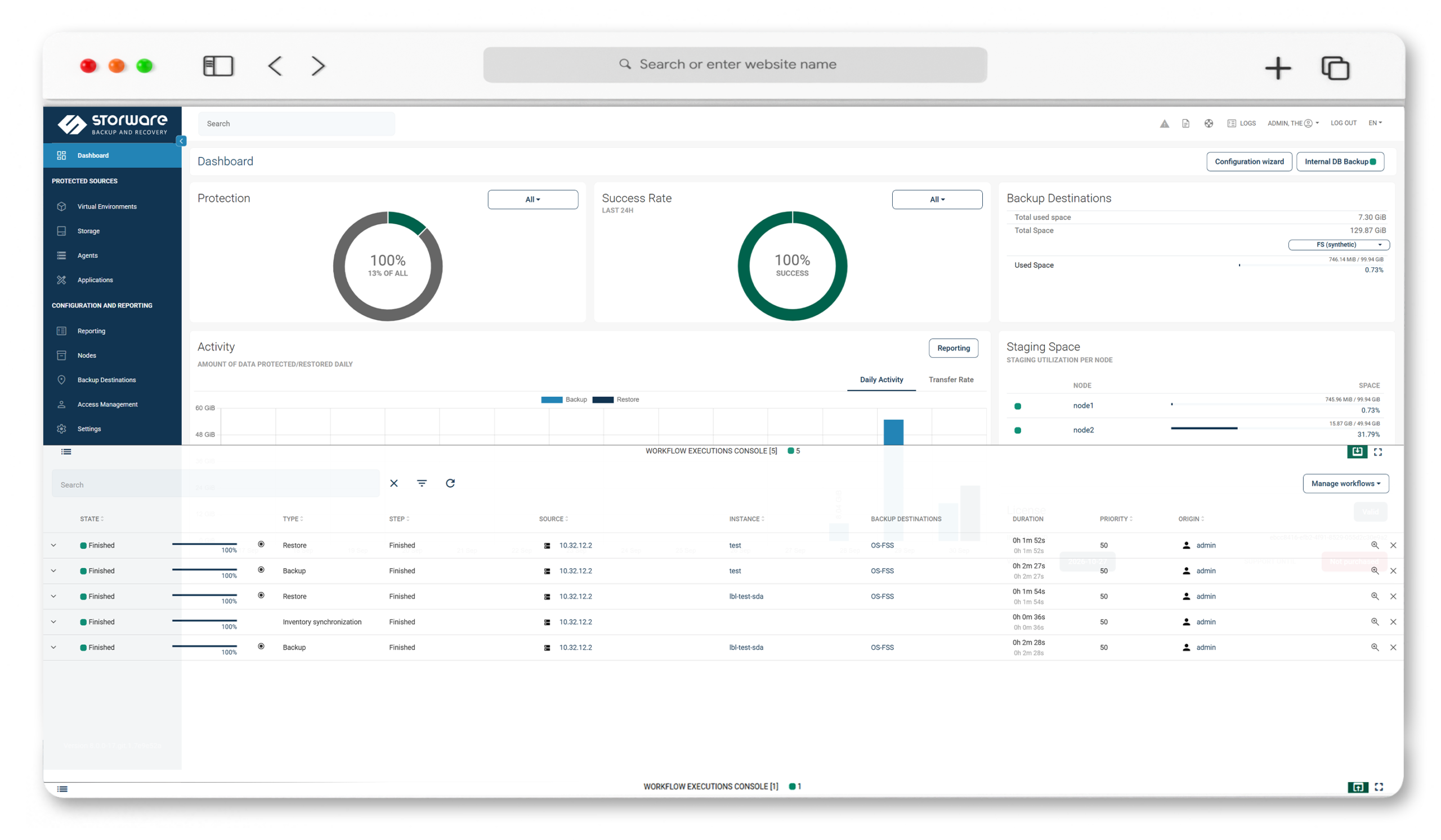
Key Highlights

Your VMware backups are the recovery source
Existing vSphere backups restore straight into OpenStack. No separate product to license, no conversion pipeline to build and maintain.

Data protection continuity on both sides
The same platform protects vSphere and OpenStack. Coverage never pauses while both environments run side by side.

One universal license for both platforms
vSphere and OpenStack are covered under a single license. No per-VM or per-socket fees, no feature tier to unlock.

EU-based data protection
Warsaw headquarters with EU-based engineering, support and control plane. Backup metadata stays under European jurisdiction.
VMware-to-OpenStack recovery, built into the platform
Cross-hypervisor restore for vSphere → OpenStack
Introduced in v7.1, cross-hypervisor restore recovers VMware backups directly into OpenStack: Red Hat OpenStack Platform, Canonical OpenStack, Virtuozzo Infrastructure, OpenMetal, Platform9 and community deployments.
Agentless vSphere source
vCenter is added as a Virtualization Provider through its API, with nothing installed inside guests. ESXi 7.0 and 8.0 are supported as backup sources.
Disk conversion and driver injection built in
VMDK is converted to QCOW2 or RAW, with guest driver injection and OpenStack instance creation handled inside the restore. No manual conversion step, no intermediary appliance.
Cinder-aware target placement
The recovery wizard maps storage to Cinder volumes, assigns the target network and sets the instance flavor. VMware resources are mapped to OpenStack equivalents in one flow.
Fresh restore points with CBT
Full and incremental backups with Changed Block Tracking keep restore points current, so recovery into OpenStack starts from recent data. Recover workloads in planned groups instead of all at once.
Protection continues after recovery
The same policies protect recovered workloads in OpenStack: IsoLayer air-gap, WORM immutability, AES encryption, Keycloak MFA, RBAC and Recovery Plans. No second tool, no re-architecture.
Native OpenStack integration
Agentless protection through Keystone, with Horizon and Skyline UI integration, multitenancy and RBAC.
Recovery back to VMware
The original vSphere backups stay available, so any workload can be restored to its original VMware environment at any time.
Technology partners






VMware and OpenStack side by side, protected by one platform
Many enterprises run VMware and OpenStack at the same time. Two platforms should not mean two backup tools, two licenses and two sets of policies.

Inconsistent policies
Separate tools create coverage gaps and different retention rules on each platform. Storware applies one policy model to vSphere and OpenStack.
Audit continuity
Retention, access control and audit trails must stay consistent across platforms. One platform keeps one record of what was protected and recovered.
Operational overhead
Every additional tool needs licensing, training and support. One console and one license cover both environments.
Platform freedom
Backups taken on VMware can be recovered in OpenStack whenever you decide. Your data protection layer does not tie you to a single platform.
Data protection under European jurisdiction
Your backup vendor is a sovereignty decision, not only a technical one. Storware's control plane, engineering and support are EU-based, which supports GDPR data residency and NIS2 and DORA supply-chain requirements for both VMware and OpenStack environments.
Data residency (GDPR)
GDPR covers the backup metadata catalogue, not just the workload payload. A control plane operated under US jurisdiction creates a measurable compliance question. Storware's is EU-based by design.
Supply-chain rules (NIS2 & DORA)
NIS2 (in force from October 2024) and DORA (applicable from January 2025) require demonstrable supply-chain and ICT third-party resilience — including your backup vendor. Storware is used by EU public-sector and regulated-industry customers under both.
CLOUD Act exposure
US-headquartered vendors can be compelled to produce data held anywhere, creating documented tension with GDPR Article 48. Storware sits outside that extraterritorial jurisdiction.
See VMware-to-OpenStack recovery end to end
Watch Storware Backup and Recovery take a vSphere VM from backup to a running, protected OpenStack instance: disk conversion, resource mapping and validation included.
How does Storware recover VMware VMs to OpenStack?
Storware backs up vSphere VMs agentlessly through the vCenter API. Cross-hypervisor restore then recovers a selected restore point into OpenStack, converting VMDK to QCOW2 or RAW, injecting guest drivers and mapping storage, network and flavor.
Which VMware and OpenStack versions are supported?
ESXi 7.0 and 8.0 are supported as backup sources. Supported OpenStack targets include Red Hat OpenStack Platform, Canonical OpenStack, Virtuozzo Infrastructure, OpenMetal, Platform9 and community deployments. Check docs.storware.eu for the current support matrix.
Do I need a separate tool or appliance?
No. Recovery into OpenStack is part of Storware Backup and Recovery. Your existing VMware backups are the recovery source, and conversion happens inside the restore.
Do I need to install agents?
No. vSphere is protected through the vCenter API and OpenStack through Keystone, with nothing installed inside guests on either side.
Can I recover Windows VMs to OpenStack?
Yes. Windows 10/11 Pro and Windows Server 2019/2022 are supported guest operating systems, with driver injection handled during the restore.
Can I restore a workload back to VMware?
Yes. Your vSphere backups remain available, so any workload can be restored to its original VMware environment.
Can Storware protect VMware and OpenStack at the same time?
Yes. One platform protects both environments with the same policies, immutability and Recovery Plans, under one universal license.
Is Storware subject to the US CLOUD Act?
No. Storware is headquartered in Warsaw, with EU-based engineering, support and control plane. See Data Sovereignty and Compliant Backup for details.