

Storware Backup and Recovery for OpenStack
The #1 backup for OpenStack. Storware protects large, multi-tenant OpenStack clouds agentlessly — driven by the OpenStack service APIs and built to scale with your deployment. Data protection continuity across every project, availability zone, and storage backend.
Key Highlights

Native to the OpenStack services
Backup and restore driven through Nova, Cinder, Glance, Neutron, and Keystone — with support for current releases up to and including 2026.1 "Gazpacho".

Built for multi-tenancy
Scoped and unscoped domain authorization with role inheritance down to projects. Every tenant's data stays isolated and independently recoverable.

Storage-aware, automatic incrementals
One automated disk-attachment strategy selects the right incremental method per volume — Ceph, Cinder, or Everpure array-level changed-block tracking — with no manual configuration.

Scales with your cloud
Horizontally scalable nodes with multi-Ceph and multi-cluster support for distributed OpenStack environments
Powerful Data Protection Features for OpenStack
Agentless, API-driven backup
Full and incremental backups through the OpenStack APIs (Nova, Cinder, Glance, Neutron) — no agents on compute nodes or in guests.
Automated disk-attachment strategy
A single, automated disk-attachment strategy selects the appropriate incremental backup method for each volume based on its storage backend — Ceph or Cinder — simplifying configuration while keeping backup, merge, and replication efficient. Existing backups stay compatible.
Native Ceph RBD change tracking
Direct Ceph RBD integration, reading changed blocks via snapshot differencing for efficient incrementals across Ceph-backed environments.
Everpure changed-block tracking
Native changed-block tracking for Everpure volumes used with the disk-attachment strategy — using Everpure snapshots and array-level change information to read only allocated blocks for full backups and only changed blocks for incrementals, reducing data read and transferred.
Instance, volume, and port metadata protection
Protect the metadata associated with instances, volumes, and ports, and restore it together with the VM — preserving more of the original workload configuration and deployment characteristics. Fully compatible with existing backups.
Security Groups on restore
Security Group support in the Horizon and Skyline consoles means network security settings are included in the backup and applied during restore.
Horizon and Skyline integration
Run backup and restore directly from the OpenStack dashboards. Skyline plugin packages can be tailored per customer for flexible deployment and integration.
Multi-tenancy and RBAC
Multi-domain authentication and role-based access isolate tenants and teams, with self-service for tenant-level backup and recovery.
Immutability, air-gap, and DR
IsoLayer air-gap, Object Lock, Retention Lock, AES encryption, and Keycloak MFA, with Recovery Plans and scheduled DR testing — plus V2V migration into OpenStack from the same backups.
Technology partners





Supported across every OpenStack distribution
Storware protects OpenStack the same way wherever it runs — through the standard service APIs (Keystone, Nova, Cinder, Glance). Upstream or vendor-distributed, the engine, the licensing, and the policies stay the same.
Canonical OpenStack
Charmed OpenStack and Sunbeam, in the Ubuntu ecosystem.
Canonical OpenStack backupVirtuozzo Infrastructure
OpenStack-based hyperconverged IaaS, built for service providers and backup-as-a-service.
Virtuozzo Infrastructure backupSee Storware Backup and Recovery for OpenStack in action
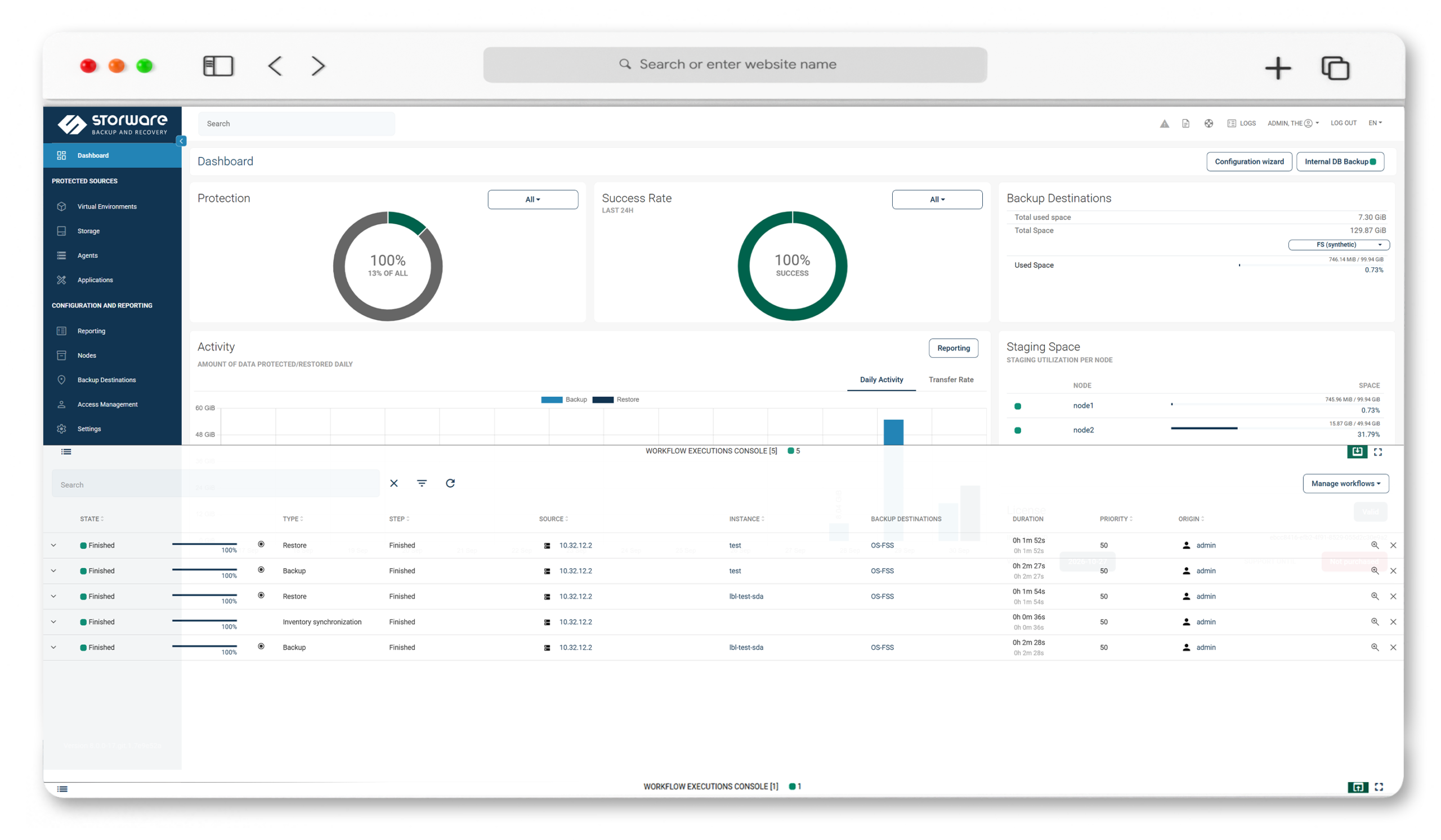
Backup, restore, and scheduling for OpenStack don't require a separate console. Watch how Storware operates directly inside the OpenStack dashboard through the Horizon and Skyline plugins — running full and incremental jobs, browsing recovery points, and restoring instances without leaving the environment your teams already use.
Frequently Asked Questions
Which OpenStack releases does Storware support?
Current OpenStack releases through 2026.1 “Gazpacho”. Confirm the full supported-version range against the 8.0 documentation.
Is OpenStack backup agentless?
Yes. Backups run through the OpenStack APIs (Nova, Cinder, Glance, Neutron) with no agents on compute nodes or in VMs — the Storware Node only needs API access.
How does Storware handle different OpenStack storage backends?
A single automated disk-attachment strategy selects the incremental method per volume based on the backend — Ceph RBD snapshot differencing, Cinder, or native Everpure changed-block tracking — so only changed blocks are read and transferred, without manual configuration.
What is Everpure changed-block tracking?
Native changed-block tracking for Everpure volumes: Storware uses Everpure snapshots and array-level change information to identify allocated blocks for full backups and only changed blocks for incrementals, improving backup performance while keeping an incremental baseline.
Does Storware protect OpenStack metadata, not just VM disks?
Yes. It protects the metadata associated with instances, volumes, and ports, and restores it with the VM — preserving more of the original configuration. Network Security Group settings are also applied during restore via Horizon and Skyline.
Can tenants run their own backups?
Yes. Native Horizon and Skyline integration, multi-domain authentication, and RBAC give tenants self-service backup and restore scoped to their own projects, while administrators keep central control. Skyline plugin packages can be tailored per customer.
Which OpenStack distributions are supported?
Vanilla OpenStack plus major distributions — Red Hat OpenStack Platform, Canonical (Sunbeam), OpenMetal, Platform9, Sardina FishOS, and Virtuozzo Infrastructure — under one universal license.