

Red Hat OpenStack Backup and Recovery
Storware protects Red Hat OpenStack Platform — 17.1 (director-based) and 18.0 (Services on OpenShift) — agentlessly, through the standard service APIs on your RHEL compute nodes. Full and incremental backups, instant restore, and V2V into OpenStack, under one license. Available on Red Hat Marketplace.
Key Highlights

RHOSP 17.1 and 18.0 (RHOSO)
One platform protects both the director-based Platform and the new 18.0 architecture, Red Hat OpenStack Services on OpenShift.
Agentless on RHEL
No agents on your compute nodes. Protection runs through Nova, Cinder, and Glance, with direct Ceph RBD access.

Red Hat ecosystem
Available on Red Hat Marketplace and backed by OpenInfra Foundation membership.

Enterprise multi-tenancy and BaaS
Scoped and unscoped domains with RBAC, and white-label BaaS/DRaaS for service providers.
Powerful Data Protection Features for Red Hat OpenStack
Two current backup strategies
Disk attachment and Disk attachment with generic incremental (preferred), both Cinder-based through a Proxy VM per availability zone.
Generic and Ceph RBD CBT incrementals
Backend-independent generic incremental via block-level checksum; on Ceph RBD — common in Red Hat OpenStack — CBT-like incrementals fetch changed blocks directly from the Ceph monitors.
Instant restore
A dedicated NFS-backed restore path for tight recovery objectives, with optional live migration to production storage.
V2V into Red Hat OpenStack
Restore VMware backups — and, since 7.5, Citrix Hypervisor and XCP-ng — directly into Red Hat OpenStack, so protection continues through migration.
Granular and cross-cloud recovery
Recover files, volumes, single VMs, or full instances, and rebuild an instance in another OpenStack cloud from captured metadata and flavors.
Native Horizon integration
Schedule and run backups and restores from the Horizon dashboard, with multi-tenant, multi-domain, RBAC-aware access.
Storage-agnostic
Protect across any Cinder backend — Ceph RBD, NFS, iSCSI, LVM — with source and destination independent of each other.
Open REST API
Fully documented REST API for DevOps, CI/CD, and infrastructure-as-code; assign policies by VM name or Nova tag.
Immutable, air-gapped security
IsoLayer air-gap, immutable backup destinations, retention lock, RBAC and access management, Keycloak MFA, and encryption in transit and at rest.
Technology partners











See Storware protecting Red Hat OpenStack
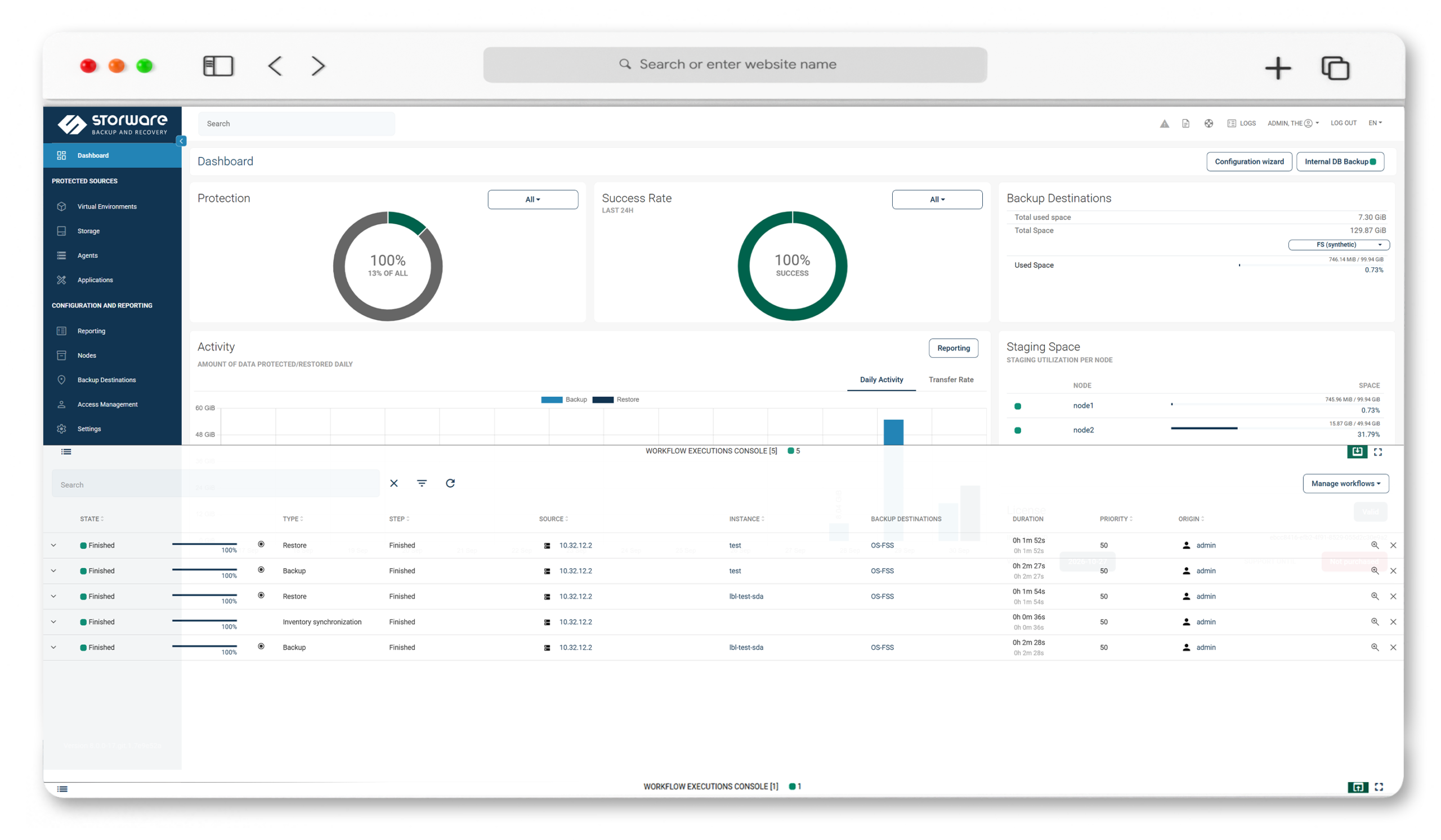
Register your Red Hat OpenStack Platform — 17.1 or 18.0 — and Storware discovers instances, Cinder volumes, and Nova tags through the APIs, runs full and incremental backups on your RHEL compute nodes, and recovers VMs granularly or instantly. No agents on your compute nodes.
Frequently Asked Questions
Does Storware support Red Hat OpenStack Platform?
Yes. Storware protects Red Hat OpenStack Platform 17.1 and 18.0, working through the standard OpenStack service APIs on your RHEL compute nodes.
Is Storware agentless on Red Hat OpenStack?
Yes. There are no agents on your compute nodes. Storware works through Nova, Cinder, and Glance, with direct Ceph RBD access and a Proxy VM provisioned per availability zone.
Which Red Hat OpenStack versions does Storware support?
Red Hat OpenStack Platform 17.1 (director-based) and 18.0 (Red Hat OpenStack Services on OpenShift). Confirm the exact supported versions against the current documentation at docs.storware.eu before deployment.
How does Storware perform incremental backups on Red Hat OpenStack?
Through disk attachment with generic incremental (storage-backend-independent, block-level checksum) or, on Ceph RBD, CBT-like incrementals with changed blocks fetched from the Ceph monitors.
Does Storware support Red Hat OpenStack Services on OpenShift (18.0)?
Yes. Storware protects the OpenStack workloads — instances and volumes — on the 18.0 Services-on-OpenShift architecture through the same standard service APIs.
Can I migrate VMware to Red Hat OpenStack with Storware?
Yes. Storware provides V2V migration from VMware — and, since 7.5, Citrix Hypervisor and XCP-ng — directly into Red Hat OpenStack, so data protection continues throughout the migration.
Can service providers run BaaS or DRaaS on Red Hat OpenStack?
Yes. Multi-tenant isolation, white-label capabilities, and per-VM, per-host, or per-TB licensing make Storware a fit for BaaS and DRaaS on Red Hat OpenStack.
How does Storware protect Red Hat OpenStack backups against ransomware?
Through immutable backup destinations, IsoLayer air-gap, and retention lock, which keep recovery points from being altered or deleted.