
Storware Backup and Recovery 8.0 is available now. The release puts OpenStack first again: support for OpenStack 2026.1 “Gazpacho”, a single disk attachment strategy that picks the right incremental method per volume, and native changed-block tracking for Everpure storage. It also moves Nutanix integrations to API v4, adds SUSE Virtualization (Harvester), and rebuilds the platform foundation for long-term support.
Table of Contents
OpenStack: backup and recovery for the latest release
OpenStack remains the core of Storware Backup and Recovery. Version 8.0 keeps data protection continuity in step with the platform and removes configuration work from day-to-day operations.
OpenStack 2026.1 “Gazpacho” support
Storware Backup and Recovery 8.0 supports OpenStack 2026.1 “Gazpacho”. Teams can upgrade their clouds to the latest release without a gap in backup and disaster recovery coverage.
Additional metadata protection
Storware now protects additional OpenStack metadata linked to instances, volumes and ports. This metadata is restored together with the virtual machine, so recovered workloads keep more of their original configuration and deployment characteristics. Less manual rework follows a restore.
The feature is fully compatible with existing backups.
One disk attachment strategy for Ceph and Cinder
Version 8.0 introduces a single disk attachment strategy for OpenStack. Storware selects the right incremental backup method for each volume based on the underlying storage, including Ceph and Cinder.
Administrators no longer choose a method per storage backend. Backup, merge and replication operations stay efficient, and configuration becomes simpler across multi-backend clouds.
Everpure changed-block tracking
For Everpure (formerly Pure Storage) volumes used with the OpenStack disk attachment strategy, Storware now offers native changed-block tracking (CBT). The integration uses Everpure snapshots and array-level change information:
- Full backups read only allocated blocks.
- Incremental backups read only changed blocks.
Less data is read and transferred, which shortens backup windows and reduces load on production storage. Each run also keeps an incremental baseline for the next one.
Security Groups in Horizon and Skyline
The native OpenStack UI integration now supports Security Groups in both the Horizon and Skyline consoles. Network security settings can be included and applied during restore, so recovered instances come back with the right access rules.
Customer-specific Skyline plugin packages
Storware now supports customer-specific Skyline plugin packages. This gives more flexibility for deployment and integration in OpenStack environments with their own packaging or release process.
Nutanix: API v4 across volume groups and files
Version 8.0 moves both Nutanix integrations to the v4 API, so Nutanix AHV and Nutanix Files protection stays aligned with current Nutanix environments.
Nutanix Volume Group storage provider on API v4
Storware now supports Nutanix AHV environments managed by Prism Central 7.5 and newer through the Nutanix v4.x API. Backup and restore can use API-based data transfer. That means fewer infrastructure dependencies and simpler data protection workflows.
Nutanix Files on API v4
The Nutanix Files integration now uses the v4 API for backup and restore. It improves compatibility with current Nutanix environments and introduces a more flexible agent-based processing model.
What stays the same:
- File-level access through Protected Data.
- Restore with skip and overwrite options, without removing existing content at the destination.
Ready to protect your data?
Kubernetes and SUSE Virtualization
Version 8.0 widens Kubernetes-based protection and brings a new virtualization platform under the same workflows.
SUSE Virtualization (Harvester) support
Storware now supports backup and restore of virtual machines running on SUSE Virtualization (Harvester). Protection runs through the Kubernetes integration, so Harvester workloads are managed with the same Kubernetes data protection workflows teams already use. For organizations moving off legacy hypervisors, this adds another destination with platform freedom and no vendor lock-in.
Deployments without a StorageClass
Backup now completes successfully in Kubernetes environments where no StorageClass is defined. Clusters with non-standard storage setups no longer fall outside backup coverage.
Token-based Kubernetes authentication
Username and password authentication for Kubernetes has been removed. Connections now use token-based authentication, in line with current Kubernetes security standards and supported methods.
Action before upgrade: Kubernetes connections that still use username and password must be switched to tokens.
Backup destinations and integrations
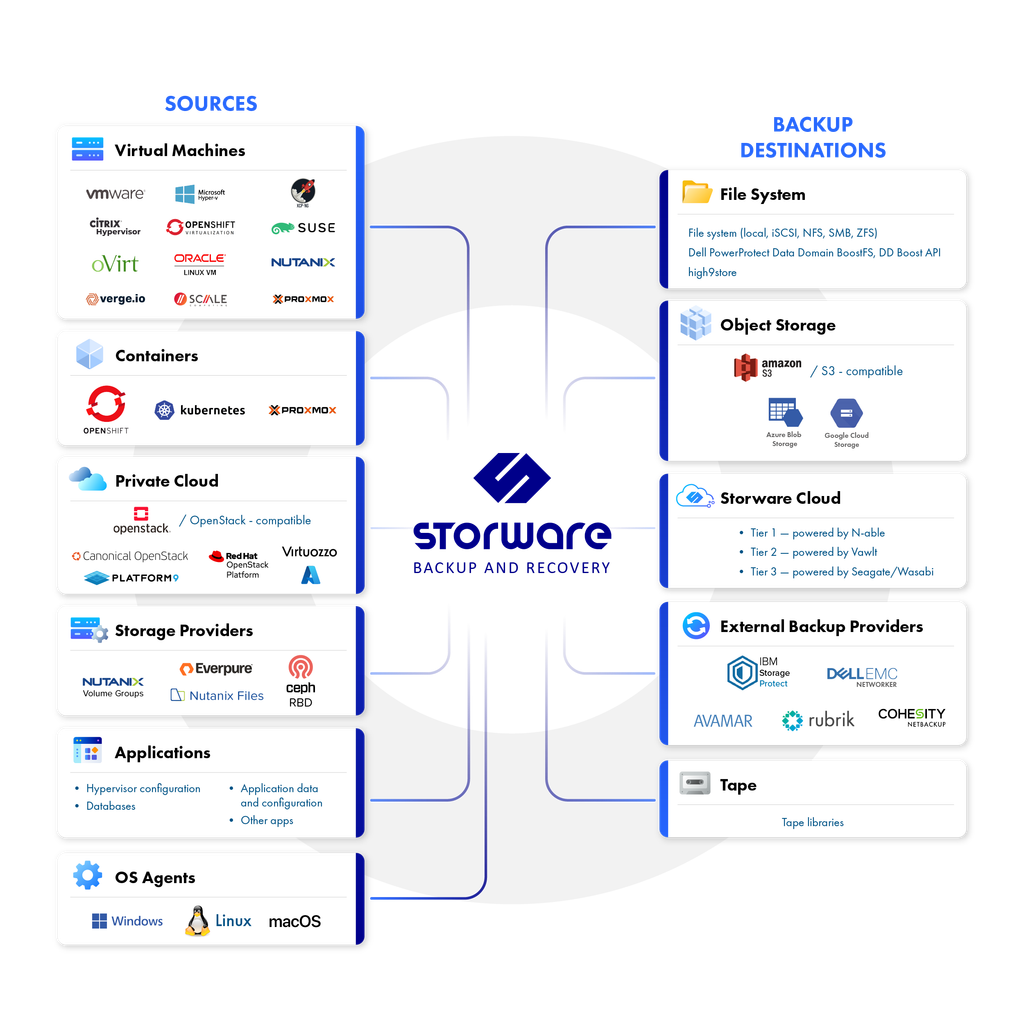
Storware is source- and destination-agnostic. Version 8.0 adds destination choices and makes data movement more efficient.
9livesdata deduplication backup target
Storware now integrates with the 9livesdata deduplication backup target as a new synthetic file system option. Environments that rely on deduplicated storage get one more backup destination to choose from.
NetBackup Client 10.5.1 and 11.2
Storware now supports NetBackup Client 10.5.1 and 11.2 through a new integration approach. Backup data streams directly to NetBackup, without first building a complete intermediate file. The result is lower staging space requirements and more efficient data transfer.
The existing integration remains available for previously supported environments.
Faster incremental export
Incremental export is faster thanks to a new data comparison method. Existing backups remain compatible, and new backup metadata uses the optimized approach.
Platform foundation: built for long-term support
Much of 8.0 happens under the hood. These changes keep the platform secure, compliant and easier to maintain over time, which matters to enterprise teams that plan upgrades years ahead.
| Area | What changed | Why it matters |
|---|---|---|
| Server API framework | Upgraded from Quarkus 2.x to Quarkus 3.x | Modernized dependencies, known vulnerabilities addressed, long-term support |
| Database | MariaDB 11.8 LTS supported; install and upgrade workflows updated | A current, long-term supported database with better security and compatibility |
| Installation | Ansible-based installer replaced with a native installation framework | More consistent, maintainable install and upgrade workflows |
| Remote Windows operations | Updated implementation for backup, restore and file transfer | More reliable and efficient Windows workflows; existing processing path stays compatible |
| ntfs-3g package | No longer installed automatically with the Node | Leaner installs; install it manually if you need NTFS-related functionality |
Storware v8 – Architecture
Lifecycle changes
Version 8.0 brings two lifecycle changes. In both cases, current customers keep what they run today.
- Red Hat Virtualization (RHV) is deprecated following the platform’s end of life. Existing RHV environments remain supported after upgrading from earlier versions, so current deployments keep their data protection continuity. For teams planning their next platform, Storware protects both the source and the destination during the move, including OpenShift Virtualization.
- New Zadara environments can no longer be added. Existing Zadara configurations remain available and keep working after the upgrade.
Before you upgrade
- Switch any Kubernetes connections that use username and password to token-based authentication.
- If your Nodes need NTFS-related functionality, plan to install ntfs-3g manually.
- Review the full release notes and upgrade guide at docs.storware.eu.
Get Storware Backup and Recovery 8.0
Storware Backup and Recovery 8.0 is available now for new and existing customers. Request a demo to see the new OpenStack, Nutanix and Kubernetes capabilities in your own environment, or start a free trial.